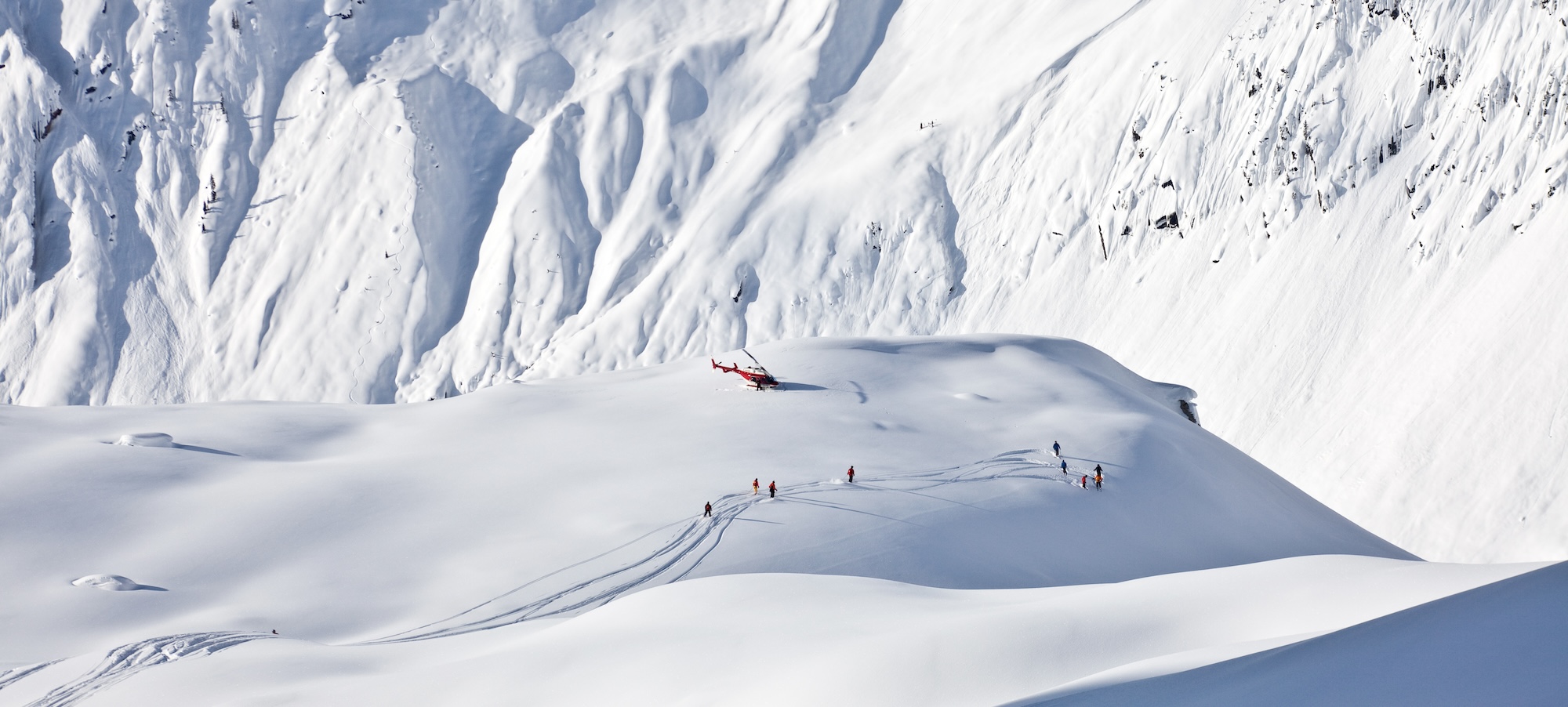
Where the World Ends and the Mountains Begin: Private Journeys to the Dolomites
Private Luxury Journeys to the Dolomites, Northern Italy — Designed by Sculptured Journeys
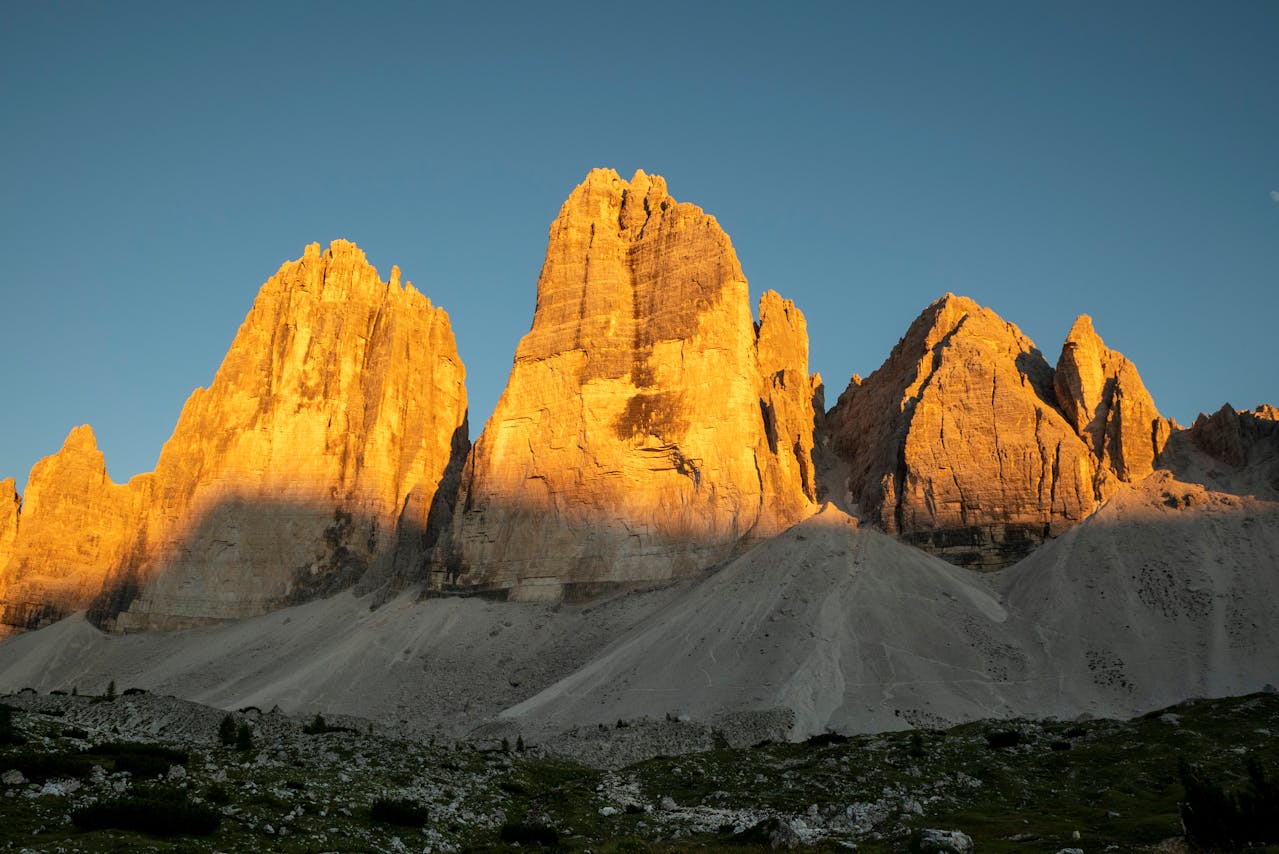
There is a moment — if you are paying attention — when northern Italy changes register entirely. The plains dissolve behind you. The valleys narrow. The road begins to climb. And then, without ceremony, they appear: columns of pale stone rising from the forest with a verticality that seems to defy ordinary geology.
You understand, instinctively, that you have arrived somewhere that operates on different terms.
The Dolomites do not ease you in. They impose themselves — on your senses, your sense of scale, and ultimately on whatever preoccupations you arrived carrying. Few landscapes on earth possess this quality. Fewer still hold it across such breadth and variety: nine distinct massifs, 142,000 hectares across three Italian provinces, each with its own geological signature, its own villages, its own character across the seasons.
The Dolomites do not ease you in. They impose themselves.
We have designed private journeys in these mountains long enough to know what they do to people. We know the trails and the ridgelines, the rifugi worth spending a night in, the valleys that receive the afternoon light in a way that makes conversation stop. We know the guides who know this landscape not as a product, but as a home.
This is what Sculptured Journeys brings to the Dolomites. Not an itinerary. A perspective — built from years of presence in a place that rewards exactly that.
These mountains do not merely impress. They restore something. Guests leave carrying what they did not arrive with — a quietude, a clarity, a sense of scale that is difficult to articulate and impossible to forget.A Landscape of World Significance
The Dolomites entered the UNESCO World Heritage List in 2009 — recognised as a site of Outstanding Universal Value under the 1972 Convention Concerning the Protection of the World Cultural and Natural Heritage. Of the 1,100-plus sites currently inscribed, fewer than 200 carry natural designation. That the Dolomites stand among them reflects something immediately evident to anyone who travels here: this is irreplaceable.
The range's recognition as a UNESCO World Heritage landscape speaks to a geological and visual drama that has no equivalent in the Alps.
The scientific significance is as profound as the visual. These formations are a geological archive — the compressed record of tropical seabeds, volcanic upheaval and tectonic collision spanning 250 million years. The pale dolomitic rock was named for the French geologist Déodat de Dolomieu, who first studied its composition in the eighteenth century. It is a sedimentary limestone of rare density, capable of the vertical formations that define the skyline: towers, spires and sheer walls rising above 3,000 metres with an architectural precision that no human hand could replicate.
UNESCO designation brings not only recognition but obligation — a binding international commitment to the stewardship and sustainable development of this landscape. We take that seriously. It shapes how we travel here, with whom, and what we ask of the environment that receives us.
The People of the Peaks
The Dolomites have been inhabited for millennia. The communities that live here carry a cultural inheritance unlike anything else in the Alps. The Ladin people — whose language descends from Vulgar Latin, filtered through centuries of mountain isolation and layered with Rhaetic and Germanic influence — occupy the valleys of the Alta Badia, Val Gardena, Val di Fassa and the Cortina d'Ampezzo basin. Ladin remains a living language: spoken in schools, published in newspapers, heard on the trails.
Ladin culture expresses itself quietly. In Val Gardena, through woodcarving — a tradition centuries deep, practised still in workshops where the smell of fresh timber is as much a part of the atmosphere as the views outside. In the Alta Badia, through mountain mythology, festival dress of considerable intricacy, and the particular quality of hospitality that shapes the region's finest hotels.
The light that falls on the Dolomites at dusk — turning pale rock from white to amber to rose — is called the Enrosadira. The Ladin people have a name for it because they have been watching it, in reverence, for a very long time.
We design our private journeys to include these dimensions. Not as cultural tourism — but as the deeper context within which this landscape makes sense.
Private Dolomites Journeys — Designed by Sculptured Journeys | Every itinerary is bespoke. Built around the individual. Delivered with private guiding, world-class hotels, and the expertise of a team with years of firsthand presence in this landscape.
PRIVATELY GUIDED DOLOMITES EXPERIENCES
The Dolomites reward every form of physical engagement — from the most contemplative valley walk to the most demanding technical ascent. What they require, in return, is the right guide: someone who reads the weather, adapts the day, and brings a guest into genuine relationship with the landscape rather than simply across its surface.
Every guide we work with holds UIAGM/IFMGA certification — the highest international qualification in mountain guiding. Beyond that, we select for personality and depth: these are professionals who love what they do, and it shows.

Via Ferrata — The Iron Paths
The via ferrata — the iron paths — are the most distinctly Dolomitic of all mountain experiences. Fixed iron cables, stemples and ladders protect routes that would otherwise demand full technical climbing competence, opening the high ridgelines to those who are adventurous, fit and prepared to be genuinely tested.
The Val di Fassa routes are among the most celebrated in the entire massif — exposed traverses above sheer valley drops, revealing the full architectural scale of the Dolomites. These are not introductory experiences. They are routes of real consequence, led by guides of real authority. All harness, helmet and via ferrata equipment is provided.
Rock Climbing and Ice Climbing
For those who wish to move beyond fixed routes, the Dolomites offer some of the finest rock climbing in Europe. The dolomitic limestone is both demanding and rewarding — clean, solid, endlessly varied. We arrange private guided climbing from introductory single-pitch routes to multi-pitch alpine objectives, calibrated entirely to the guest's experience and ambition.
In winter, the discipline transforms entirely. Ice climbing on the frozen falls and mixed routes of the high valleys is a pursuit of extraordinary intensity — a complete immersion in the cold architecture of the winter mountains. We offer this as part of our winter multi-sport programmes, always with certified guides and full technical equipment.
Hiking — From Valley Floor to High Wilderness
To walk the trails of the Dolomites is to move through a sequence of entirely distinct worlds. Alpine pastures give way to scree slopes; forests open onto plateau systems of improbable breadth; mountain passes reveal valley panoramas that extend across three provinces.
We design multi-day traverses that cross between massifs and natural parks — through the Parco Naturale Puez-Odle, the Parco Naturale Fanes-Sennes-Braies, the Parco Naturale Paneveggio-Pale di San Martino — each carrying its own ecological identity. The wilderness trails of the Pale di San Martino belong to another register entirely: a high limestone plateau of otherworldly silence, where the stone is almost white and the views extend to the edge of perception.
Mountain Biking and Road Cycling
The Dolomites offer cycling terrain of exceptional range. The legendary road passes — Passo Sella, Passo Gardena, Passo Campolongo — carry a weight in Giro d'Italia history that adds its own dimension to the experience of riding them.
For mountain biking, we design routes to technical ability and pace, with private guiding and full logistical support throughout. E-bikes extend range without sacrificing immersion. For road cycling, we arrange private guided rides across the great passes, with profiles tailored to fitness and ambition.
Lake Braies — On Foot and by E-Bike
Pragser Wildsee — Lake Braies — is genuinely singular. Set within the Fanes-Sennes-Braies nature park, enclosed by forested slopes and pale cliffs, the lake's turquoise surface reflects the surrounding massif with an almost implausible clarity.
The silence here, in the early morning before the day walkers arrive, produces a particular kind of stillness. We access it both on foot and by e-bike, which extends the range of exploration without diminishing the quality of the experience. Private early-morning access is among the more sought-after elements of a Sculptured Journeys itinerary in this region.

Multi-Sport and Curated Private Discoveries
Beyond individual disciplines, some of our most compelling Dolomite programmes combine multiple forms of engagement across several days — hiking one morning, road cycling the next, a via ferrata ascent followed by a rifugio night, then a descent by e-bike to a luxury hotel.
We also design what we call curated private discoveries: days built around a specific sensation rather than a specific activity. A morning on the high pastures above Castelrotto, where the Alpe di Siusi plateau extends to the horizon in every direction. A private visit to a Ladin woodcarving atelier in Ortisei. A sunrise ascent to a rifugio, front-row for the Enrosadira. The experience of drinking spring water from a mountain source above 2,000 metres — water of a purity that is, in itself, worth the climb.
These mountains have air that resets the body and water that restores it.
We believe, without qualification, that time spent here at the right pace and with the right intention is genuinely transformative. This is not marketing language. It is what our clients tell us, consistently, when they return.
THE VALLEYS AND VILLAGES
Cortina d'Ampezzo — The Queen of the Dolomites
Cortina at dusk has a quality that is difficult to prepare for. The surrounding peaks — the Tofane, the Cristallo, the Sorapiss — hold the last light long after the valley floor has fallen into shadow. The town below moves at its own register: unhurried, conscious of itself, animated by the particular confidence of a place that has been receiving discerning guests for well over a century.
This is the Cortina that rewards patience. The social energy of the Corso Italia is one experience; the silence of the trails above town at first light is another entirely. The skiing — across the linked Dolomiti Superski circuit — is exceptional in scale and variety. In summer, the hiking in the immediate surroundings is among the finest in the range. What distinguishes Cortina and other Dolomite centres is not primarily the mountains — it is the atmosphere that the mountains have, over time, attracted and sustained.
Sculptured Journeys works with Cortina's finest properties. Rosapetra Resort & Spa is set in Zuel di Sopra, a quiet hamlet south of the town centre, where the pace slows and the surrounding peaks retain their full presence without the distraction of the Corso Italia below. The spa is among the most considered in the Dolomites — a genuine retreat within a retreat — and the alpine interiors carry a refinement that feels earned rather than arranged. For guests who want Cortina's access and the beauty of its mountain setting at a deliberate remove from its social register, Rosapetra is the natural choice.
Hotel de Len, in the heart of the village, offers something complementary: central position, genuine warmth of hospitality, exceptional cocktails and a cuisine that takes its local sourcing seriously — a property whose sense of character no amount of renovation could manufacture. Cortina has also welcomed a notable new arrival — Ancora Cortina, now open in the heart of the town — adding further to what is already one of the most compelling accommodation landscapes in the Italian Alps.

Val Badia and Alta Badia — The Ladin Heartland
The Val Badia is, for many who know the Dolomites well, its emotional centre. Sixteen kilometres in length, oriented between the Sella group and the Fanes plateau, it holds a concentration of landscape, culture and hospitality that is exceptional even by Dolomite standards.
The Parco Naturale Fanes-Sennes-Braies frames the valley to the north and east, encompassing the villages of Braies, Dobbiaco, Badia, La Valle, San Vigilio di Marebbe and Valdaora within its protected boundaries. The Fanes plateau itself — accessible by trail and mountain guide — is among the most remote and atmospheric environments in the entire UNESCO zone.
Corvara sits at the southern end of the valley, at the foot of the Campolongo pass, with views toward the Puez-Odle ridge to the west. It is a village that rewards extended time: small enough to be intimate, sufficiently served to be comfortable, and positioned at the intersection of some of the finest ski and hiking terrain in the range.
Val Gardena — Beauty, Craft and the Puez-Odle Wilderness
Val Gardena is one of the most beautiful valleys in the Dolomites, and one of the most culturally distinctive. The main village, Ortisei, is the woodcarving capital of the Alps — a tradition practised here since the seventeenth century, still alive in workshops lining the village streets where master carvers work in the same tradition as their ancestors.
Above Val Gardena to the north, the Puez-Odle Nature Park rises to a plateau of remarkable drama and silence — high dolomitic rock, ancient pastures, and trails that reveal the full scale of the massif. The park towers above both Corvara and Colfosco in the Alta Badia, making it accessible across a multi-day itinerary from multiple valley bases. Selva di Val Gardena, at the head of the valley, sits directly beneath the Sassolungo group — arguably the most compositionally striking of all the Dolomite massifs.
Alpe di Siusi — Europe's Largest Alpine Plateau
The Alpe di Siusi is unlike anything else in Europe: the largest high-altitude alpine plateau on the continent — 56 square kilometres of open pasture and meadow, rising above Val Gardena at elevations between 1,800 and 2,350 metres. In summer, a sweep of wildflower broken only by occasional farmsteads and the distant profiles of the Sassolungo and Sciliar. In winter, one of the finest ski-touring and cross-country landscapes in the Alps.
Castelrotto is the largest village of the plateau and its historic centre. COMO Alpina Dolomites — ski-in, ski-out on the plateau itself — offers direct access to the Alpe di Siusi terrain and the Val Gardena circuit beyond, with the COMO group's characteristic approach: considered design, serious wellness programming and rigorous sourcing in the kitchen.
Val Pusteria — Breadth and Quiet
The Val Pusteria runs east to west across the northern Dolomites — wider, more pastoral than the southerly valleys, with a sense of openness unusual in this landscape. The Tre Cime di Lavaredo rise at the eastern end of a side valley, accessible from Dobbiaco, making the Pustertal a natural base for combining the most iconic panorama in the range with quieter valley pleasures.
It is also dairy country. The Graukäse producers here — making aged grey cheese of sharp, pungent character with little or no fat — represent one of the most distinctive food traditions in the Alps. We build private producer visits into itineraries for guests with a serious interest in what this land actually tastes like.
Madonna di Campiglio — The Western Dolomites
At the western edge of the Dolomite world, in the Adamello-Brenta massif, Madonna di Campiglio has a refinement and consistency of quality that makes it among the most coveted winter addresses in northern Italy. The ski circuit is superb. The village is polished without being affected. For guests whose itinerary crosses from the eastern to western Dolomites, it provides a natural and highly pleasurable conclusion.
For those wishing to move between properties across the range rather than settle in a single valley, a more extended exploration of the valleys in winter is laid out in our Dolomites hotel-to-hotel ski safari piece.
WHERE WE STAY
The Dolomites have assembled one of the finest collections of luxury mountain properties on earth. Every hotel we recommend has been assessed through direct personal experience — not against category benchmarks, but against the specific demands of our clients and the standards we hold ourselves to. These are not suggestions. They are commitments.
A fuller portrait of these properties — room categories, dining, spa — is gathered in our Dolomites property portrait.
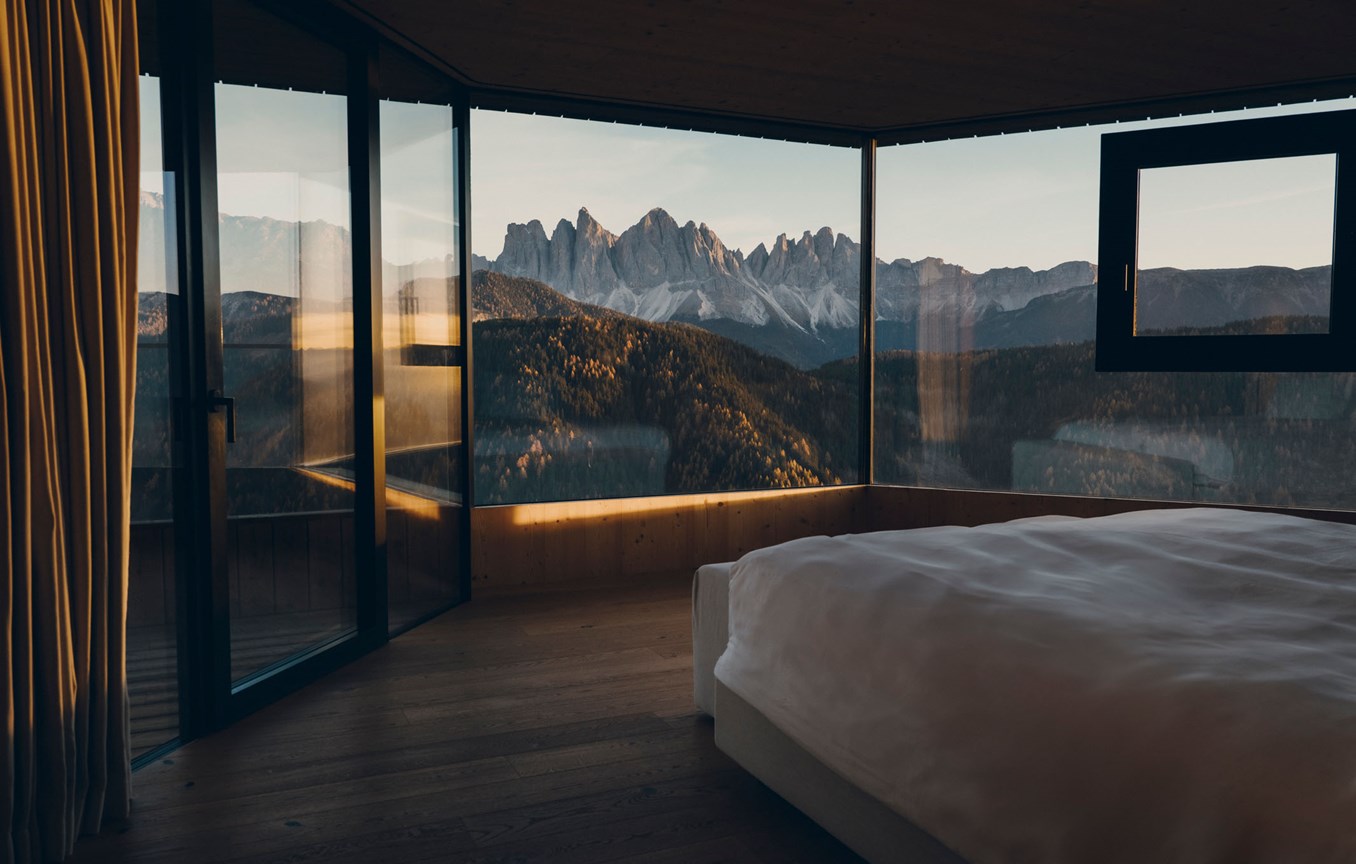
Forestis Dolomites — Plose Mountain, above Brixen
Read our Forestis Dolomites story →
Forestis is, for those who know it, genuinely unlike anything else. Set at 1,800 metres above Brixen on the southern slope of the Plose mountain — directly opposite the Dolomite massifs, which rise across the valley in full and quietly superb view — the property was conceived around a philosophy of restoration through altitude, air, water and silence.
Its architecture realises this with total conviction: stone, glass and timber reduced to their essentials, leaving only the relationship between interior and landscape.
A note on location, because it matters: Forestis sits on the foothills of the South Tyrolean Alps, with the UNESCO Dolomite peaks visible at a distance of one to one-and-a-half hours. It is not inside the Dolomites — but it is, in every meaningful sense, of the mountains. The nearest Dolomite peak, Monte Putia above Passo delle Erbe, is thirty minutes away and accessible by a superb circular trail.
We include Forestis in our itineraries because it offers what valley-floor hotels cannot: altitude, air of exceptional purity, and a degree of remove that makes it an extraordinary place to begin a journey — or to close one.
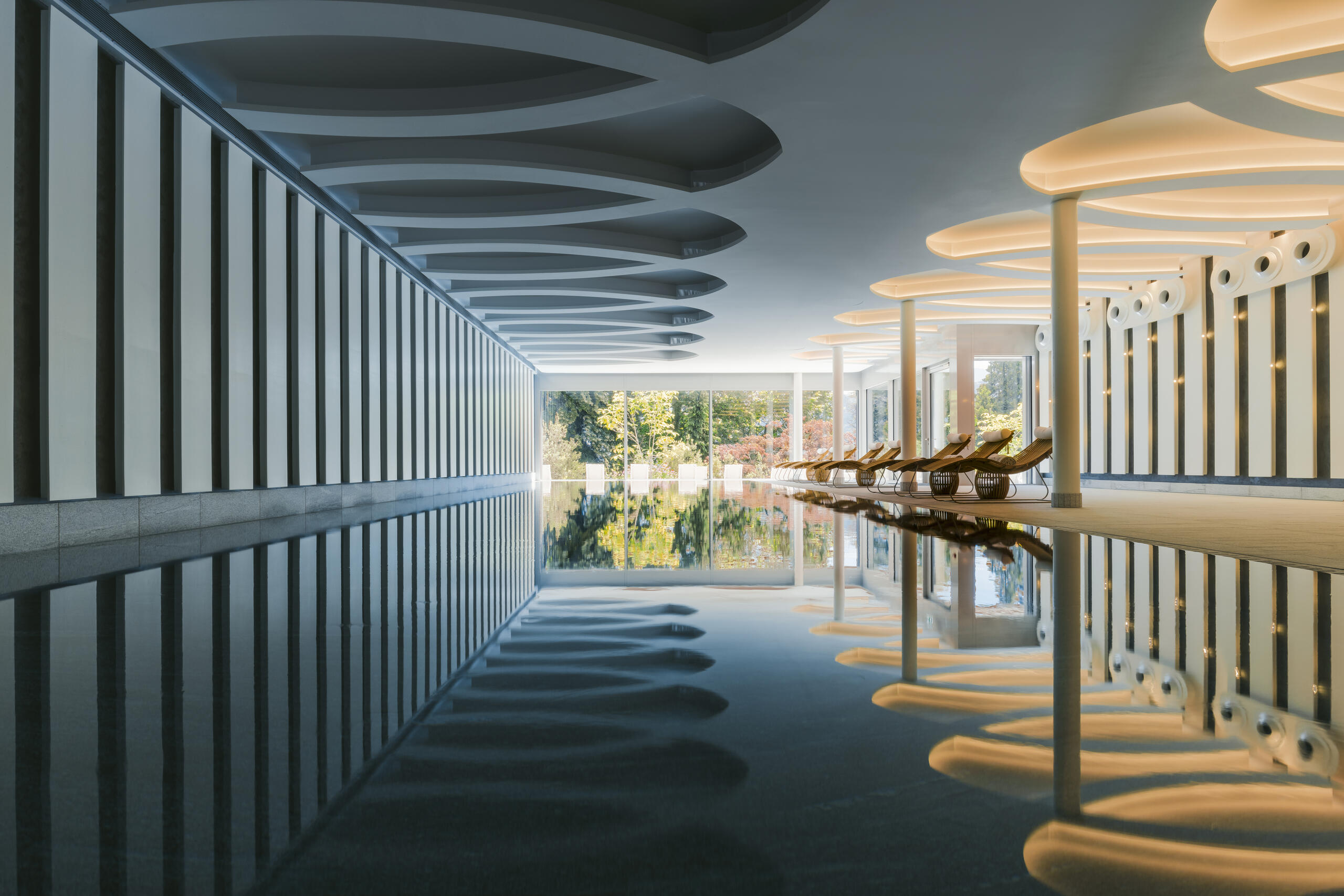
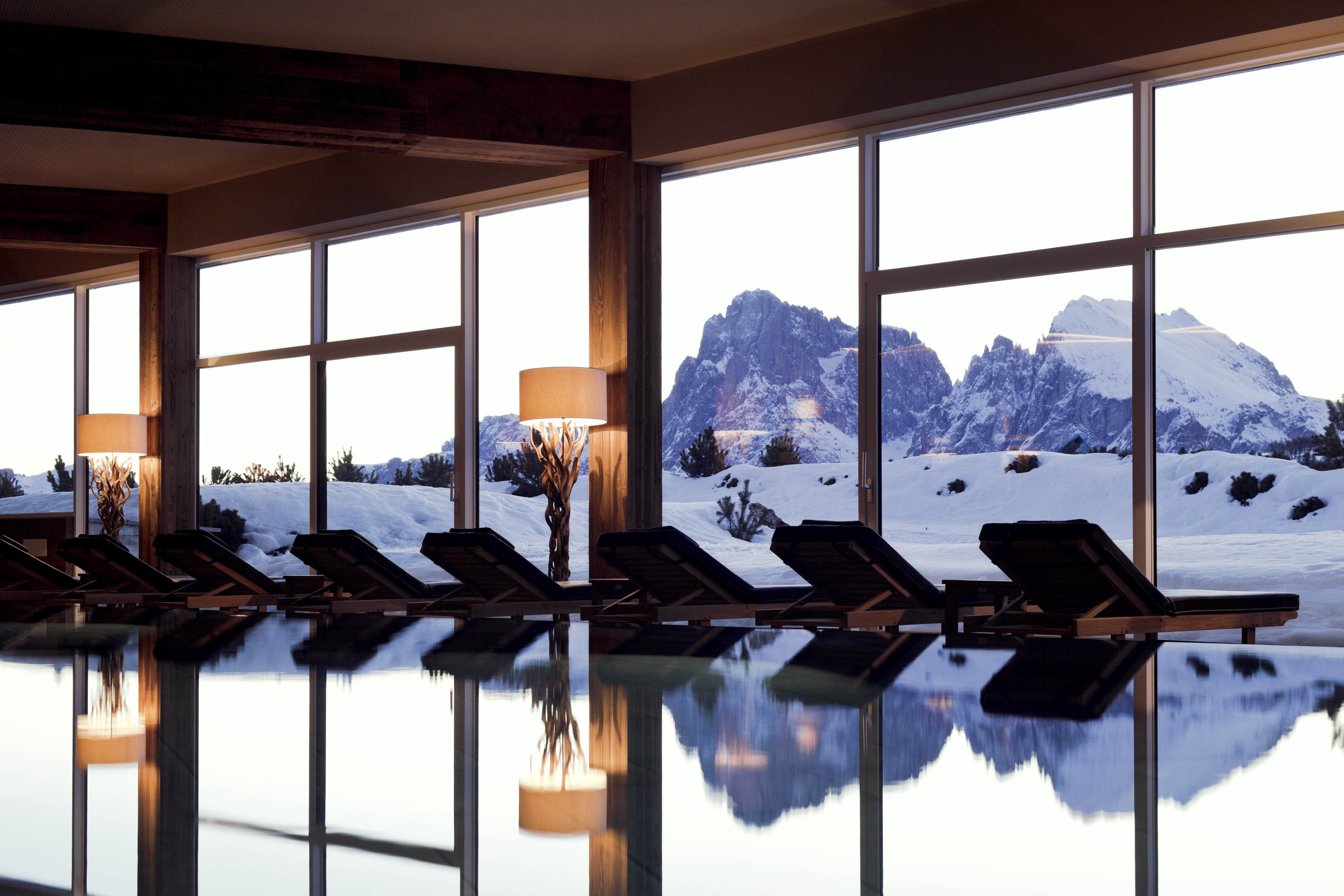
The spa is among the most architecturally singular in the Alps: pools and treatment spaces that dissolve the boundary between interior and exterior, with views that make stillness automatic. The restaurant, Forest Cuisine, works with regional ingredients at altitude — and altitude changes the character of food as surely as it changes the character of the air.
Gardena Grödnerhof — Ortisei, Val Gardena
There are hotels that have been built, and hotels that have been grown. The Gardena Grödnerhof belongs to the second category, and the distinction matters. A multi-generational family property in the heart of Ortisei, shaped over decades by a single family's sustained commitment to quality and place — it carries an authority that no renovation programme could manufacture.
Anna Stuben — the hotel's restaurant — holds a Michelin star in 2026. The kitchen sources primarily from the region: alpine herbs, mountain dairy, local game, valley producers. The food tastes of where it comes from, and the traditional stube dining room adds a warmth that a more designed space would lose.
The spa is one that our founder, Melissa J. Martin, returns to consistently for the quality of its restorative effect — treatments conceived around alpine botanicals and thermal water, in spaces that understand the purpose of a mountain spa not as luxury gesture but as genuine recovery. For guests moving through the Dolomites on a multi-property journey, the Grödnerhof provides something essential: a sense of inhabiting a place rather than passing through it.
Aman Rosa Alpina — San Cassiano, Alta Badia
Read our Aman Rosa Alpina story →
Rosa Alpina has been the soul of San Cassiano for generations. Hugo and Ursula Pizzinini built this property from the ground up — pouring decades of personal commitment into what became one of the most quietly revered alpine addresses in the Alta Badia.
When Aman acquired the property, the transformation was neither swift nor superficial. An extensive renovation, conceived by Jean-Michel Gathy of Denniston, took the time it required — and what emerged is now considered among the finest Aman properties in the world. The Pizzinini legacy was not erased by that process. It became the foundation upon which everything else was built.
The architecture is the work of Jean-Michel Gathy of Denniston — the same hand responsible for some of the most celebrated Aman properties in the world — who approached Rosa Alpina not as a blank canvas but as a house with memory. The result is a renovation of exceptional restraint: traditional alpine materials — stone, timber, handcrafted joinery — disposed with a contemporary precision that removes every excess without disturbing the warmth beneath. The interiors do not announce themselves. They settle around you.
Set in the village of San Cassiano at 1,537 metres, beneath the peaks of La Varella and Conturines, the property sits within the 29,652-acre Dolomiti Superski area — 1,200 kilometres of ski runs and 450 lifts, the largest interconnected ski circuit in the world. In summer, the trails above the valley and the broader Alta Badia hiking network place the full range of the UNESCO landscape directly at the guest's disposal.
The Aman Spa occupies two floors and operates at the scale and standard the Aman name demands. Seven treatment suites. A 20-metre outdoor heated infinity pool and an indoor pool, both with forest vistas. Jacuzzi, steam bath, Bio sauna, Finnish sauna and cold plunge pool. A yoga studio and fully equipped gym complete an offering that is less a hotel spa than a dedicated wellness destination — one that happens to be framed by the Dolomites on every side.
The atmosphere is one of profound quietude. The spaces frame the mountain views rather than competing with them. The culinary programme is anchored in the region's produce and seasonal rhythms with a seriousness that matches the setting. For guests seeking a single property that delivers the full expression of Dolomite luxury, Rosa Alpina is the answer. For those building a multi-property journey, it provides the natural conclusion.

Hotel La Perla — Corvara, Alta Badia
La Perla has been part of the fabric of Corvara since 1956, when the Costa family first opened it as a simple mountain house. Nearly seven decades later, it remains a family property — and carries the authority of a place that has earned its reputation slowly, through consistent quality and genuine hospitality.
The property houses multiple dining rooms of distinct character, anchored by La Stüa de Michil — a Michelin-starred restaurant led by chef Simone Cantafio, whose kitchen draws on Ladin tradition and broader Italian sensibility in equal measure. A wine programme extending to private cellar tastings adds depth throughout. La Perla is a hotel of real personality: warm, confident and deeply rooted in its place.
Hotel Ciasa Salares — San Cassiano, Alta Badia
Ciasa Salares is classified four-star superior, and we include it because classification in this landscape does not always tell the full story. From direct personal experience, this is a property whose warmth of hospitality, mountain setting and culinary ambition exceed the category in which it sits. We ensure our clients occupy the top suites — where the mountain views are at their most expansive and the sense of the landscape pressing in from every side is most acute.
The Michelin-starred restaurant is a serious destination in its own right. One of the largest private wine cellars in northern Italy, a dedicated cheese room and a chocolate room complete a food and beverage offering that reflects genuine commitment to the pleasures of the table. For guests travelling on itineraries where Aman is unavailable, or those who value the character of a smaller independent property, Ciasa Salares is a choice we make with confidence.
Rosapetra Resort & Spa — Cortina d'Ampezzo
Rosapetra Resort & Spa occupies a quieter position in Zuel di Sopra, just beyond the centre of Cortina d’Ampezzo, where the atmosphere shifts from social alpine energy to something far more restorative. Surrounded by forest and framed by the great peaks of the Ampezzo basin, the property feels intentionally removed without ever feeling disconnected.
The spa is among the most considered in the Dolomites — deeply calming, highly refined and designed with a genuine understanding of what mountain wellness should feel like after long days outdoors. Interiors throughout the hotel balance alpine warmth with understated sophistication, while the overall experience remains discreet, elegant and deeply comfortable.
For guests seeking Cortina with a stronger sense of retreat and privacy, Rosapetra remains one of our preferred addresses in the region.
Hotel de Len — Cortina d'Ampezzo
In the heart of Cortina d’Ampezzo, Hotel de Len offers a more understated expression of alpine hospitality — intimate in scale, deeply welcoming and exceptionally well positioned for guests who wish to experience the rhythm of the village itself.
What makes the property particularly appealing is not spectacle, but atmosphere. The hospitality feels genuine, the cocktail offering is among the best in Cortina, and the cuisine reflects a thoughtful commitment to regional ingredients and mountain traditions without unnecessary formality.
Despite its four-star superior classification, Hotel de Len delivers an experience that consistently exceeds expectation. It is exactly the kind of discreet, high-quality property we value highly at Sculptured Journeys — chosen not for labels, but for how it makes guests feel while staying there.
COMO Alpina Dolomites — Alpe di Siusi
For guests whose itinerary includes the Alpe di Siusi, COMO Alpina Dolomites occupies a position of particular rarity: ski-in, ski-out access to the plateau terrain, with Val Gardena beyond. Considered design, serious wellness programming, a kitchen committed to local sourcing — and a setting, on Europe's largest alpine plateau, that makes this one of the more unusual luxury mountain bases in the range.
Hotel Ancora — Cortina d'Ampezzo
At Corso Italia 62 — the living spine of Cortina d'Ampezzo — Hotel Ancora occupies a position that is at once central and quietly apart. Founded in 1826, it is among the oldest addresses on this street, yet its sensibility today is anything but archival. Part of the EGNAZIA Group and a member of Leading Hotels of the World, Ancora has been conceived as a home for creative minds and eclectic spirits: the Ampezzo tradition is present in the materiality and the scale, while the aesthetic leans toward the contemporary and the considered.
Eight room categories run from Superior Rooms through to the Ancora Suite, each calibrated to a different relationship with the town below and the peaks beyond. At table, the fine-dining restaurant works within a local, seasonal, sustainable philosophy — produce drawn from the valleys, technique applied with precision. The Terrazza above Corso Italia is among the more pleasurable places in Cortina to watch the town's particular theatre unfold, season by season. A Bar and Living anchors the social life of the property, and the spa — with its hydrotherapy element — and gym make the case for staying rather than always moving through.
Mandarin Oriental Cristallo, Cortina d'Ampezzo
Among the properties anticipated to redefine the Cortina landscape, the forthcoming Mandarin Oriental Cristallo warrants particular attention. The historic Hotel Cristallo — long part of the town's identity from its hillside position above Cortina — is being transformed into what will be Mandarin Oriental's first alpine resort, expected to open in early 2027. The rebrand and restoration represent a significant investment in a building that already commands one of the most commanding outlooks above the valley. It does not yet receive guests, and all details remain subject to refinement before opening — but for those planning a Dolomites journey in 2027 and beyond, it merits watching closely.
A broader look at what is arriving across the European alpine landscape, including this property, is gathered in the SCULPTURED JOURNEYS luxury hotel openings 2026–2030 piece.
THE RIFUGIO — A NIGHT ABOVE EVERYTHING
Among the most distinctive elements of a Sculptured Journeys Dolomites itinerary is the option to spend a night not in a hotel, but in a private room at a mountain rifugio. These high-altitude huts occupy positions where hotels simply do not exist — at the head of passes, beneath the great rock walls of the massif, accessible only by trail or cable car.
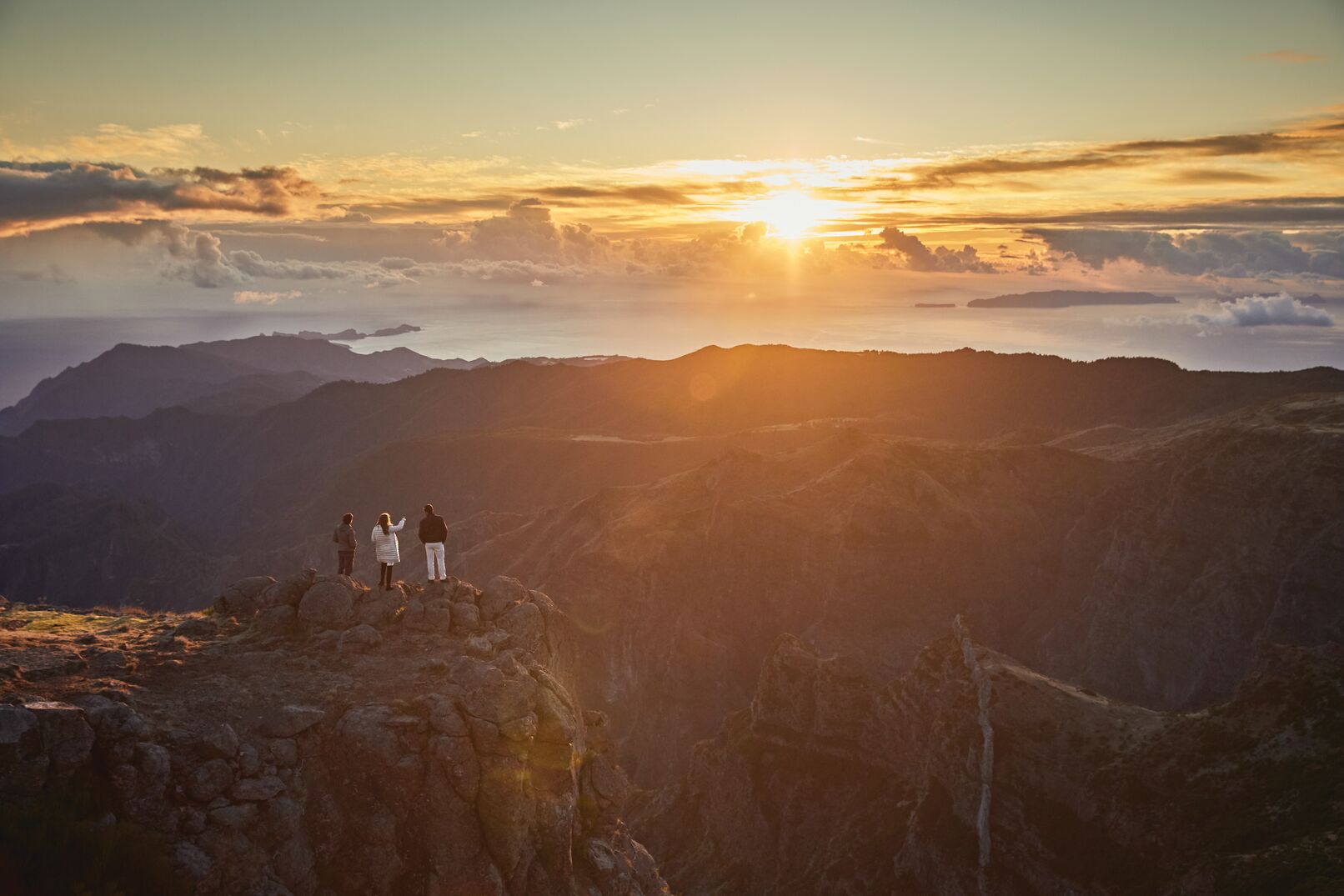
The experience is deliberately simple. Rooms are clean and quiet. Meals are generous and honest. The silence after dark is absolute. To wake at 2,000 metres, step outside before the sun has fully risen, and watch the first light find the peaks — this belongs to a category of experience that no hotel, however magnificent, can replicate.
We select only those rifugi where the standard of private accommodation is appropriate for our guests, and we embed them within itineraries that also include the finest properties in the region.
Not because it is the most comfortable experience — it is not — but because it is the most singular.
The contrast between a rifugio night and a night at Aman or Forestis is, in itself, one of the more memorable aspects of a Dolomites journey with us. We call it a hotel-to-hotel private safari. It is one of the defining features of what we offer in these mountains — and the element that clients most often describe first, when they tell others about the journey.
A PRIVATE DOLOMITES JOURNEY: ONE SUGGESTED ARC
Every Sculptured Journeys itinerary is designed privately and entirely from the ground up, shaped around the pace, interests and ambitions of each individual client.
Night 1–2: Forestis Dolomites
Begin at elevation. Forestis provides an arrival into mountain air and mountain silence that calibrates the senses for what follows. A morning hike around Monte Putia introduces the geological character of the wider landscape. The spa establishes the physical tone. The restaurant establishes the culinary standard.
Night 3–4: Gardena Grödnerhof, Ortisei
Move into the Dolomites proper. Val Gardena introduces the full visual register of the UNESCO landscape: the Sassolungo rising directly above the valley, the Puez-Odle plateau accessible by trail. Anna Stuben delivers its Michelin-starred expression of alpine gastronomy. A via ferrata day in the Val di Fassa — a private transfer of under an hour — brings the physical dimension of the journey to full intensity.
Night 5–7: Aman Rosa Alpina, San Cassiano
The final movement: into the Alta Badia and the heart of Ladin country. The Aman spa provides recovery. The skiing — or, in summer, the trail network above the valley — delivers the landscape at its most immersive. The Alta Badia light at dusk, when the Sella group takes the last sun, is the Dolomites at their most unrepeatable.
For guests wishing to include Cortina d'Ampezzo — extending to ten nights — Rosapetra Resort & Spa provides the natural conclusion: above the Queen of the Dolomites, with views across to the Tofane that bookend the journey's visual arc with something approaching completion.
ON FOOD, WINE AND THE TABLE AT ALTITUDE
The culinary culture of the Dolomites is a study in productive collision. Italian, Tyrolean and Ladin traditions meet here in a way that produces something genuinely its own: canederli alongside handmade pasta with mountain herbs; aged Graukäse from Val Pusteria dairies alongside charcuterie of Austrian character; venison from the high valleys alongside risotto made with the first spring mushrooms.
The level to which this tradition has been refined is not always anticipated by guests arriving from the better-known Italian food regions. The Alta Badia holds more Michelin stars per head of population than almost any comparable area in Europe — a reflection of genuine kitchen talent that has been attracted to, and developed within, this landscape.
What fewer guests anticipate is the quality of dining available on the mountain itself. Several of the Dolomites' rifugi serve carefully sourced local food at altitude with an honesty that no formal restaurant setting can replicate. The experience of earning a table through physical effort — then sitting above the treeline with a glass of local wine and a view across to the next ridge — is one of the Dolomites' most quietly extraordinary pleasures.
For private wine experiences, we arrange tastings with Alto Adige producers whose Pinot Blanc, Lagrein and Gewürztraminer achieve a precision that the altitude and cool climate make possible. Private appointments, not tourist programming — conversations with producers who take their work seriously, in cellars that reflect a winemaking tradition as old as the valleys themselves.
There are places that impress and places that transform. The Dolomites belong to the second category.
Private by nature. Extraordinary by design.
YOUR QUESTIONS, ANSWERED
How do I begin planning my private journey to the Dolomites?
Every Sculptured Journeys itinerary begins with a conversation. Contact us directly to discuss your interests, travel dates, and the kind of experience you are seeking. From there, we build a proposal that is entirely bespoke — no templates, no standard packages.
How do I travel to the Dolomites?
The most seamless way to reach the Dolomites for international travellers is via Venice Marco Polo Airport (VCE), the principal gateway for private journeys into northern Italy’s UNESCO-listed mountain regions. From there, Sculptured Journeys arranges private luxury transfers directly to your first property in the Dolomites.
The drive itself becomes part of the experience — moving from the Veneto plains through alpine foothills and into the dramatic high valleys of the Dolomite mountains, where the landscape gradually shifts into one of the most extraordinary natural environments in Europe
Which airport is best for travelling to the Dolomites?
Venice Marco Polo (VCE) is the most commonly used international gateway — approximately two hours' private transfer to the central Dolomite valleys. Innsbruck (INN) serves the northern approaches well. Verona (VRN) and Bolzano (BZO) offer additional options depending on routing and first destination.
Do you arrange private jet travel to the Dolomites?
Yes. Sculptured Journeys can arrange international and regional private jet charters for clients travelling to northern Italy, including seamless private transfers onward into the Dolomites. Our journeys are fully bespoke, with every logistical detail managed privately from arrival to departure.
Do you arrange private airport transfers?
All transfers — airport arrival, between properties, and every movement within the itinerary — are arranged privately by Sculptured Journeys, in professionally driven vehicles appropriate to the terrain and season.
What fitness level is required?
We customise every itinerary to the individual. Our programmes span the full spectrum — from gentle valley walks to advanced alpine traverses and technical via ferrata. We will ask honestly about fitness and experience, and design accordingly.
Can you stay overnight in a Dolomites Rifugio?
Yes — and we strongly recommend it. We select private room accommodation at rifugi of appropriate standard, embedded within itineraries that also include the region's finest luxury hotels. The contrast is, itself, one of the defining elements of a Dolomites journey with us.
Do I need my own Via Ferrata equipment?
No. Harness, helmet and via ferrata set are all provided. Suitable hiking boots with ankle support are the one item we ask guests to ensure they have — these can also be sourced locally in Cortina, Ortisei or any of the principal Dolomite villages.
What if it rains on a hiking or via ferrata day?
Our guides monitor conditions continuously and adapt routes accordingly. Via ferrata excursions are not conducted in adverse weather — our UIAGM/IFMGA certified guides will propose alternative routes or a revised schedule that makes the best of what the day offers.
What is the best time to travel for summer activities?
June through September. July and August offer the most consistently fine conditions and widest access to high routes. September is exceptional — cooler, quieter, with the first autumn colour in the lower forests and a clarity of light that makes photography particularly rewarding.
Can you drink the water in the Dolomites?
Yes. Tap water throughout the Dolomites is of remarkable quality, drawn from mountain springs. On the trail, mountain fountains and springs are equally reliable; your guide will advise on specific sources.
Do you offer travel insurance?
Travel insurance is the client's responsibility across all Sculptured Journeys destinations. For the Dolomites specifically, we recommend enrolling with Global Rescue prior to travel — a specialist emergency medical and mountain evacuation service whose expertise in high-altitude environments we consider prudent for any guest undertaking activities in this region.




.jpg)




















-002.jpg)