
Where Spain Begins
A Private Authority Guide to the Spain That Most Travellers Never Find
Spain keeps its own counsel.
There are places that offer themselves immediately — whose beauty is legible from the first moment, whose pleasures are arranged for easy consumption. Spain is not among them. It has been here too long, and has seen too much, to make that kind of effort. What it offers instead is something rarer: the sense, arriving slowly and then all at once, that you have crossed into a country with an interior life — one that reveals itself not to those who arrive with an itinerary, but to those who arrive with genuine curiosity and the willingness to stay long enough to earn it.
That interior life takes many forms. It is the particular weight of an Andalusian afternoon when the light turns gold and the air smells of orange blossom and something older than history. It is the precision of a conversation in a Basque kitchen where the food is both art and argument. It is the quality of silence in Extremadura where ancient stone absorbs the heat of the day and releases it slowly into the evening, and you understand without being told that you are standing somewhere that has no equivalent on earth.
What follows is an invitation to travel Spain as it deserves to be travelled — not as a collection of destinations, but as a country with a soul that takes time to know. Sculptured Journeys has spent years learning how to find that soul, and for whom.
Madrid — The City That Keeps Its Hours

Madrid is a city that does not begin until late. Lunch at three. Dinner at ten. The evening, which in another European capital would be winding down, is in Madrid only just gathering itself. There is something profoundly civilised about this — a refusal to hurry, a conviction that the hours of the day belong to the people who inhabit them and not to any external schedule.
The Prado contains more great paintings per square metre than almost anywhere on earth, and yet it is never quite discussed with the reverence it deserves — perhaps because Madrid itself distracts you too thoroughly. The Retiro park at dawn, when the rowing boats are still chained at the lake's edge and the rose gardens are entirely yours. The Mercado de San Miguel, not as a tourist exercise but as a genuine encounter with the produce and appetite of a city that takes eating seriously. The Barrio de las Letras, where Lope de Vega and Cervantes once lived in the same narrow streets, and where the literary ghosts are still palpable in the evening light.
At the Four Seasons Madrid, on the former site of the Banco Español de Crédito, the architecture alone commands attention — a Beaux-Arts building of extraordinary grandeur, reimagined with an intelligence that the city's history demands. The Rosewood Villa Magna sits on the Paseo de la Castellana with a quieter authority — discreet, deeply comfortable, the choice of those who have no need to announce their presence. The Mandarin Oriental Ritz, reopened after a meticulous restoration, carries within it the memory of every significant moment in Spanish cultural and political life over more than a century. And Santo Mauro, a Luxury Collection Hotel, occupies a nineteenth-century palace in the Almagro neighbourhood with a library and garden that feel entirely removed from the city surrounding them — which is, of course, precisely the point.
For those who wish to understand these properties in depth, our guide to Madrid's most extraordinary hotel suites goes further.
A fuller portrait of the city — including private experiences and how to move between Madrid and Mallorca — is found in our Private Founder’s Guide to Madrid and Mallorca
Madrid rewards the unhurried visitor. Those who give it three days discover a city. Those who give it a week discover a world.
Barcelona — Where Architecture Becomes Emotion

There are cities that you understand immediately, and cities that take time. Barcelona belongs to neither category. It does something rarer: it overwhelms you at once, and then continues to reveal itself for as long as you stay.
Gaudí’s Sagrada Família has been under construction since 1882 and will not be completed within the lifetimes of most people reading these words — and yet it is already one of the most extraordinary buildings on earth. Not because of its size, though it is immense, but because of the quality of its feeling. Standing inside it, in the light that pours through the stained glass in colours that seem to belong to a different spectrum than the one we usually see, it is almost impossible not to experience something that transcends architecture entirely.
The Eixample grid, designed by Ildefons Cerdà in the nineteenth century as a democratic utopian project, contains within it the Manzana de la Discordia — the Block of Discord — where Gaudí, Domènech i Montaner, and Puig i Cadafalch each built a masterpiece within steps of each other, as if in quiet, permanent competition. The Gothic Quarter moves in a different direction entirely: medieval, labyrinthine, occasionally vertiginous, revealing Roman ruins beneath its streets and a cathedral that has stood since the thirteenth century.
And then there is the sea. At the end of Las Ramblas, at the foot of every street that runs east from the Eixample, the Mediterranean arrives — not as a backdrop but as a destination. The Hotel Arts Barcelona stands at this meeting point, where Frank Gehry’s golden fish sculpture catches the light outside and the rooms look out over water that in certain lights appears almost luminous. On the Passeig de Gràcia, the Mandarin Oriental Barcelona occupies a position of extraordinary cultural significance — between Casa Batlló and Casa Lleó Morera, at the heart of the most architecturally consequential street in Europe. To stay here is to live, briefly, inside the history of the city.
Andalucia — The Deep South

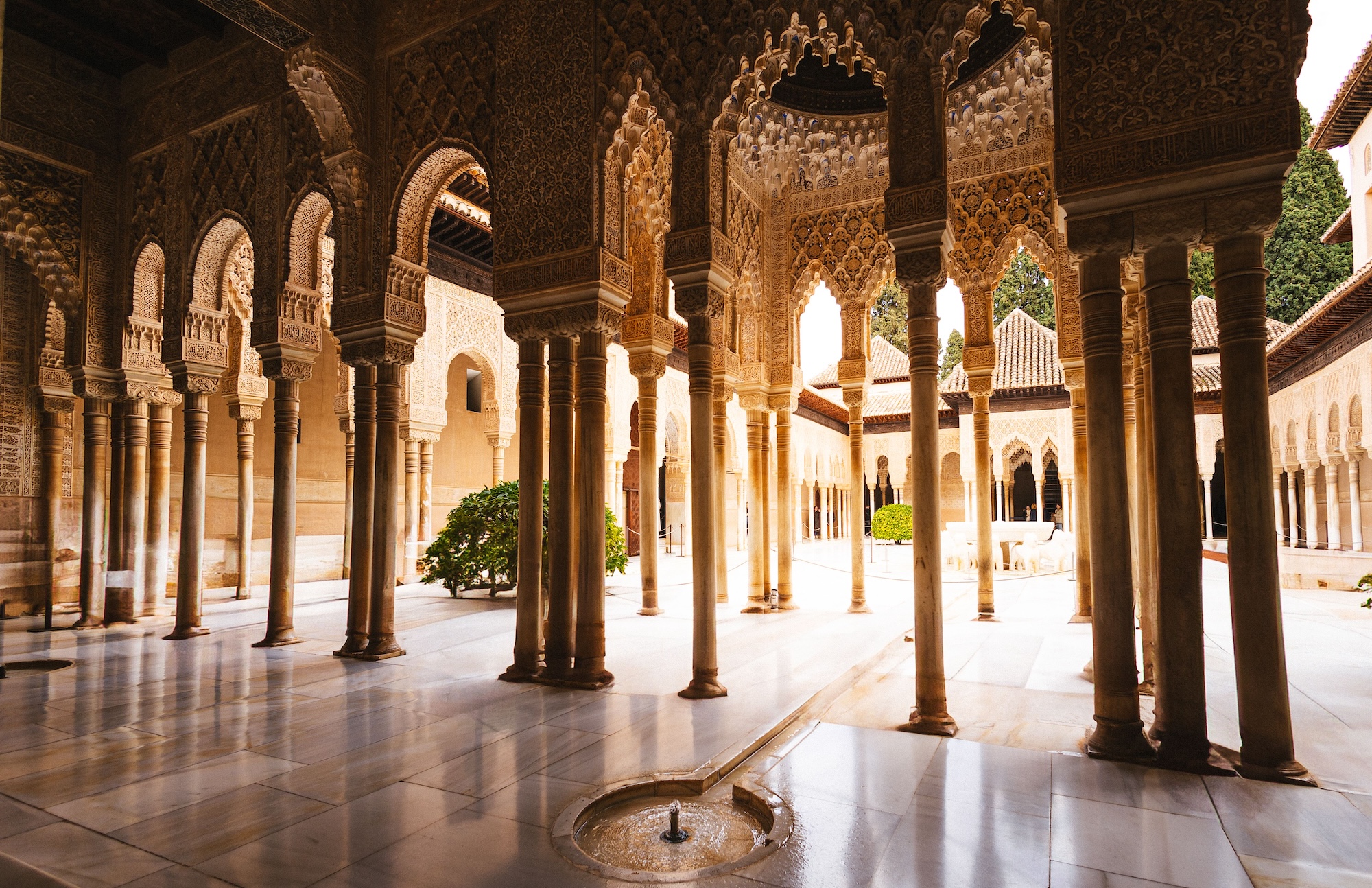
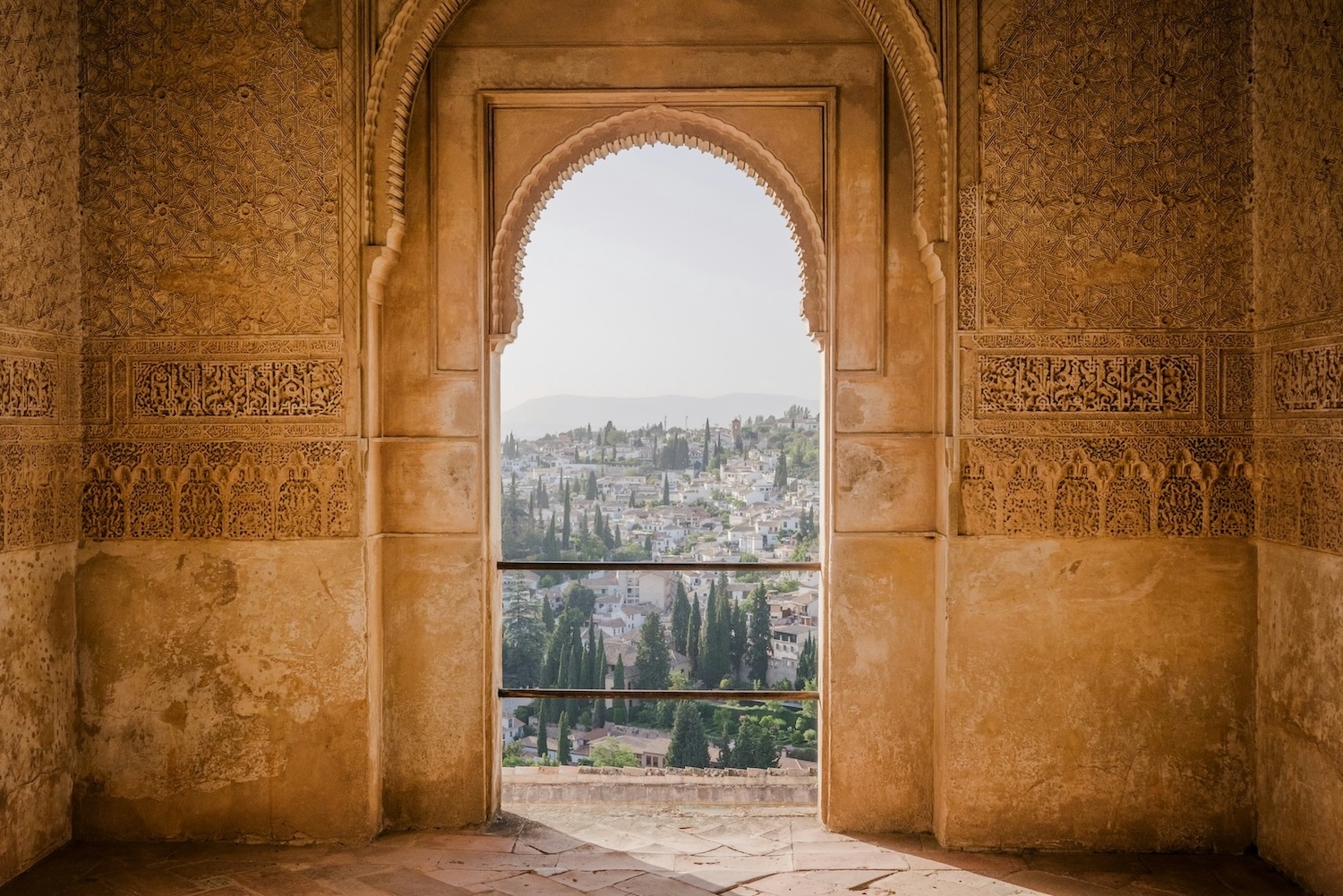
The south of Spain operates on a different emotional frequency from the rest of the country. The light is heavier here, more golden, more insistent. The architecture carries the memory of eight centuries of Moorish civilisation — in the geometric perfection of the Alhambra’s stucco, in the forest of columns inside Córdoba’s Mezquita, in the whitewashed villages of the Sierra Nevada that look from a distance like something a child might have placed on the hillside.
Granada contains one of the most complex and moving buildings ever constructed: the Alhambra, palace and fortress and garden and poem in stone, built across three centuries and carrying within its walls a vision of paradise that remains, after all this time, entirely convincing. The Generalife gardens above it, where water runs through channels designed to create the sound of coolness in a hot climate, are among the most affecting outdoor spaces in Europe.
Seville is theatre — grand, operatic, unashamed. The cathedral is the largest Gothic building in the world. The Alcázar, still a royal residence, contains gardens of extraordinary beauty. The Barrio de Santa Cruz, the old Jewish quarter, is a maze of orange-tree courtyards and whitewashed walls that in the evening fills with the kind of life that the rest of Europe seems to have forgotten how to sustain.
Córdoba offers a different register entirely — quieter, more contemplative, still marked by the extraordinary cultural synthesis of its medieval past when Muslims, Jews, and Christians lived in proximity and produced a civilisation of remarkable sophistication. The Mezquita-Catedral, a mosque converted into a cathedral by the simple act of building one inside the other, is perhaps the most physically arresting example of layered history anywhere in Europe.
Jerez moves to a different rhythm — the rhythm of the horse and the sherry cask, both of which the city has been producing to an extraordinary standard for centuries. The Royal Andalusian School of Equestrian Art stages performances that are not spectacle but discipline — a centuries-old art form of communication between horse and rider that is something very close to beautiful.
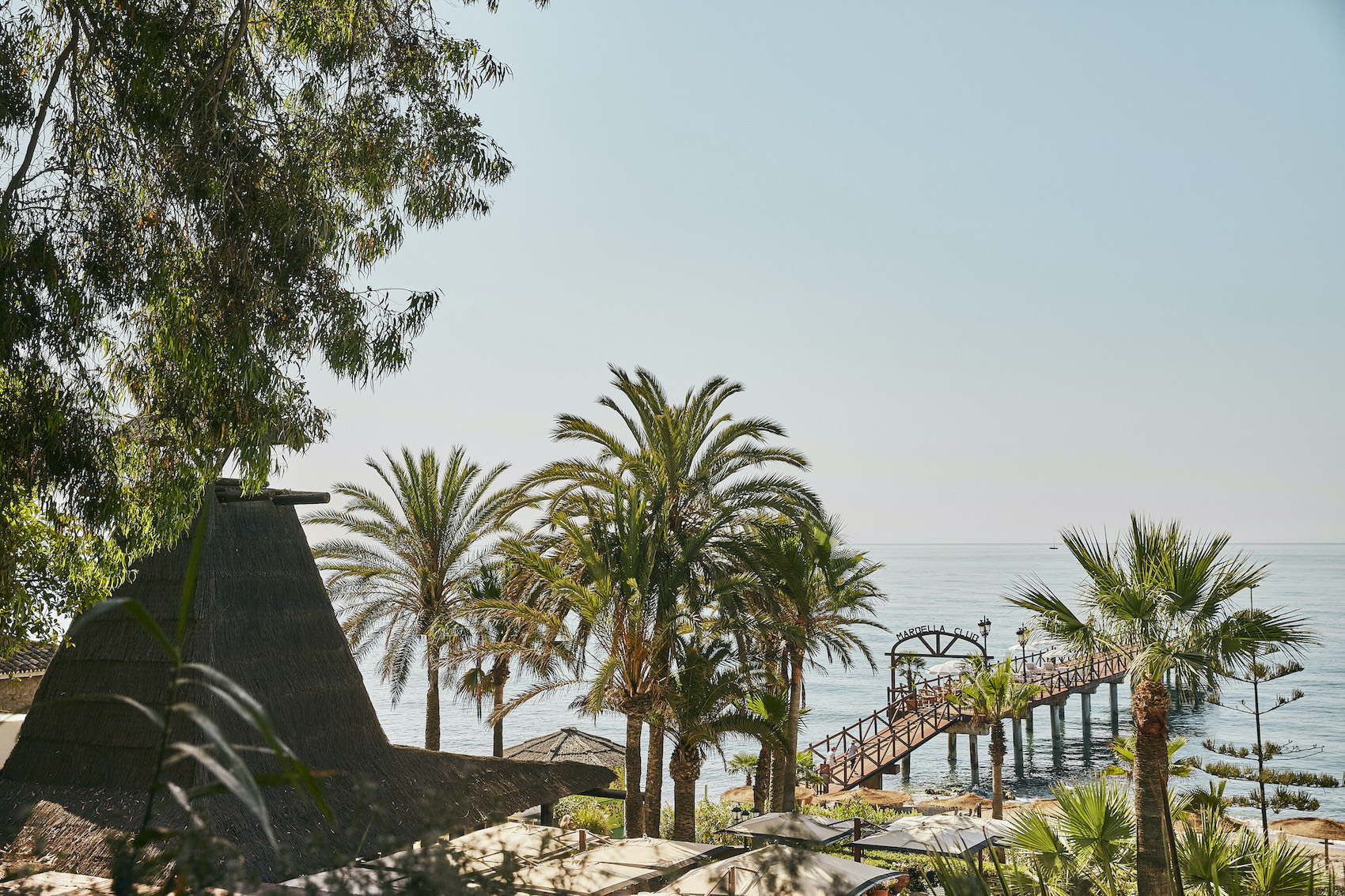
On the Costa del Sol, the Marbella Club Hotel sits on the coastline with the quiet authority of a place that has never needed to change because it was always right — founded in 1954 by Prince Alfonso von Hohenlohe on land that was then orange and avocado groves, it remains the most civilised address on the Mediterranean coast.
Our full portrait of the property is found in Marbella Club: A Mediterranean Sanctuary of Connection and Wellbeing
On the philosophy of travelling Spain with purpose and soul, read Travel with Soul: Sustainable Luxury Journeys for the Discerning Traveller
The Basque Country — Appetite and Art at the Edge of the World

The Basque Country is where Spain becomes something else — or rather, where it reveals that it was always more than one thing. The language spoken here, Euskara, is the oldest in Europe and belongs to no known linguistic family. The landscape is green and Atlantic and vertiginous. The food is among the finest on earth.
San Sebastián — Donostia in Euskara — has more Michelin stars per capita than almost anywhere in the world, which is a statistic that tells you something useful but misses the larger point. The larger point is that in this city, eating is a form of cultural expression as serious and as carefully considered as any other art form. The pintxos bars of the Parte Vieja, where small pieces of bread carry combinations of flavour that require thought and invention and skill, are the vernacular expression of this. The great restaurants — Arzak, Mugaritz, Akelarre, Martín Berasategui — are its high art.
Bilbao holds the Guggenheim Museum, Frank Gehry’s titanium masterpiece that transformed a post-industrial city into a cultural destination and gave the world the term ‘the Bilbao effect.’ To see it for the first time, arriving on foot along the river, is to understand that architecture at its most ambitious is not about buildings at all — it is about how a building makes you feel.
Galicia & the Camino — The Atlantic Edge
Galicia is the Spain that surprises people who believe they already know the country. Green and rain-swept and Celtic in its ancient roots, it faces the Atlantic rather than the Mediterranean and belongs to a different emotional geography — quieter, more melancholic, more given to the interior life.
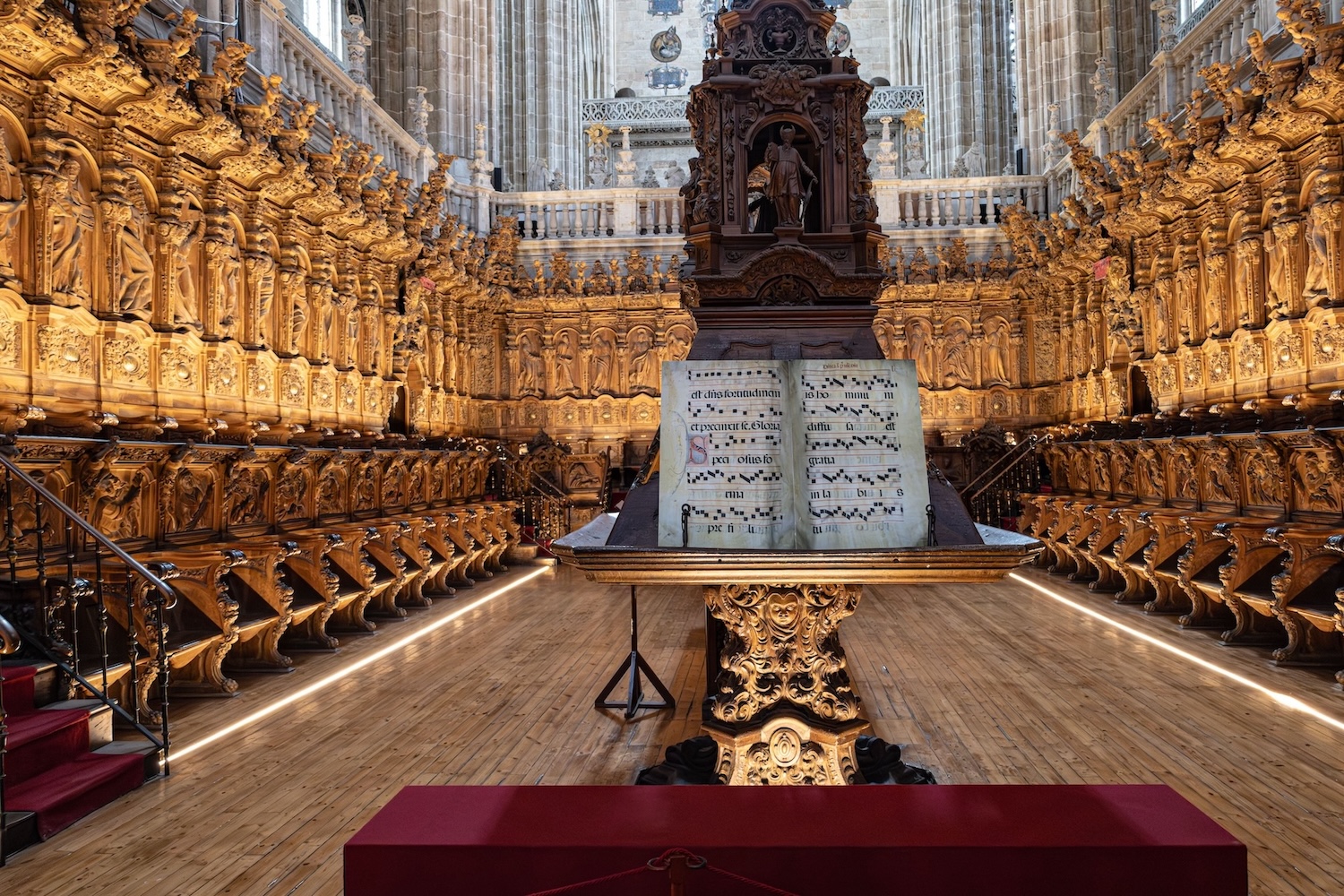
Santiago de Compostela, at the end of the Camino de Santiago, is one of the great pilgrimage destinations in the world — not only for those who walk to it, though the journey on foot is among the most transformative experiences a person can undertake, but for anyone who arrives in the cathedral square and looks up at the baroque facade of one of the most emotionally charged buildings in Christendom. People weep here, pilgrims and non-pilgrims alike, for reasons they often cannot entirely explain.
The Rías Baixas, Galicia’s coastal inlets, produce the finest albariño wine in the world — pale, mineral, alive with the salt of the Atlantic — and the finest seafood in Spain, which is the finest seafood in Europe. To eat percebes — goose barnacles — harvested by hand from the rocks in a Galician fishing village, is to understand that some of the most extraordinary things on earth are also the most local, and the most perishable.
The Balearics — Islands of Distinct Character
The Balearic Islands share a sea and a government but almost nothing else. Each has developed its own character with remarkable independence, and each rewards a different kind of traveller.
Mallorca contains within it several entirely distinct versions of itself. There is the Mallorca of Palma — a genuinely cultured city with a Gothic cathedral of extraordinary beauty, a thriving restaurant scene, and a museum collection that would honour any capital. There is the Mallorca of the Serra de Tramuntana, the UNESCO-listed mountain range along the northwest coast, where Robert Graves lived and wrote in Deià and where the landscape of olive groves and limestone peaks and terraced hillsides descending to coves of startling clarity is among the most beautiful in the Mediterranean.
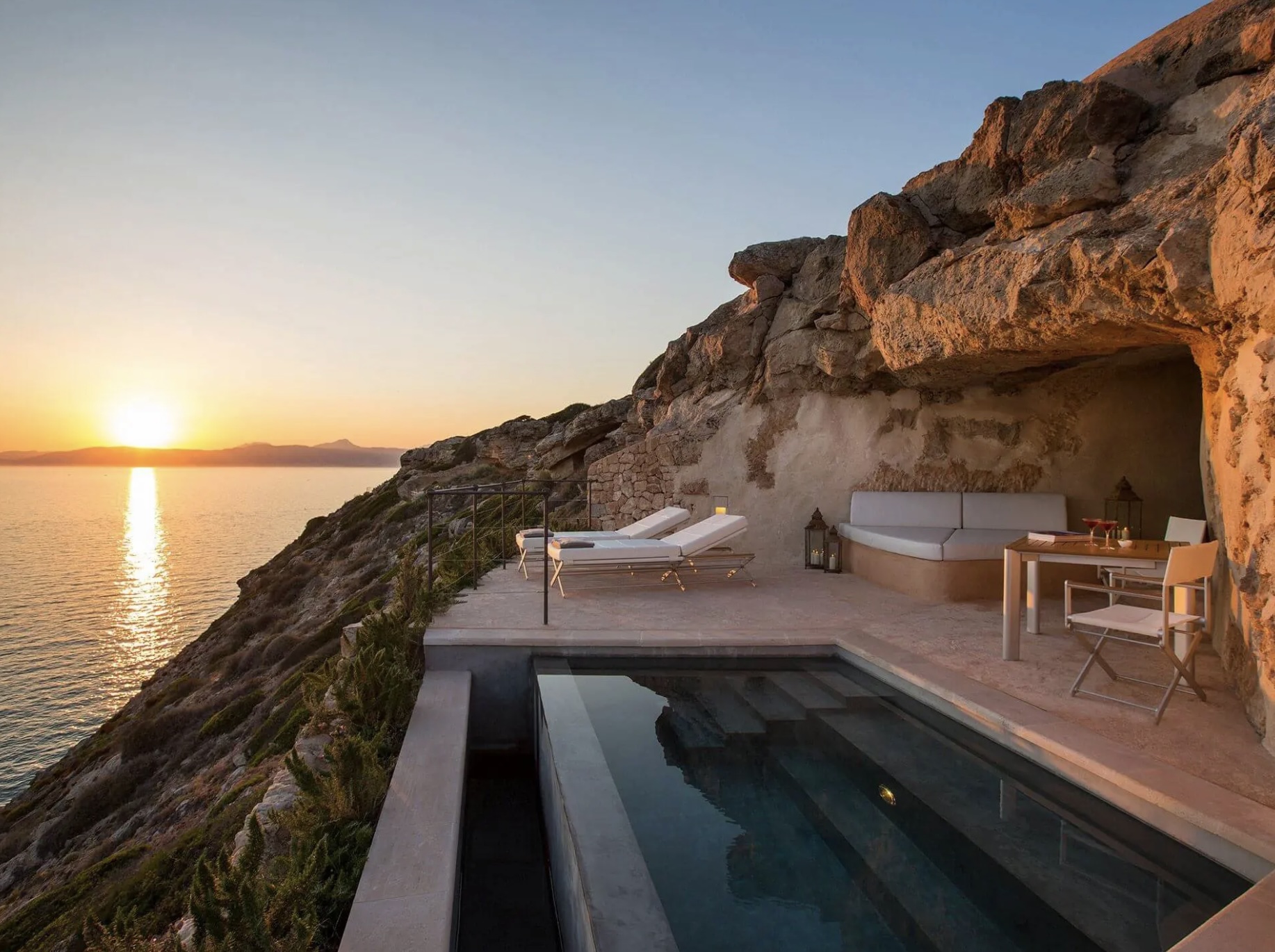
Cap Rocat, a nineteenth-century military fortress above the Bay of Palma, converted into one of the most singular private hotels in Europe, offers something that very few places on earth can offer: the sensation of complete removal. The walls that once defended a coastline now enclose a world entirely its own — suites carved into the ramparts, a saltwater pool that appears to merge with the bay below, a silence that the outside world cannot penetrate.
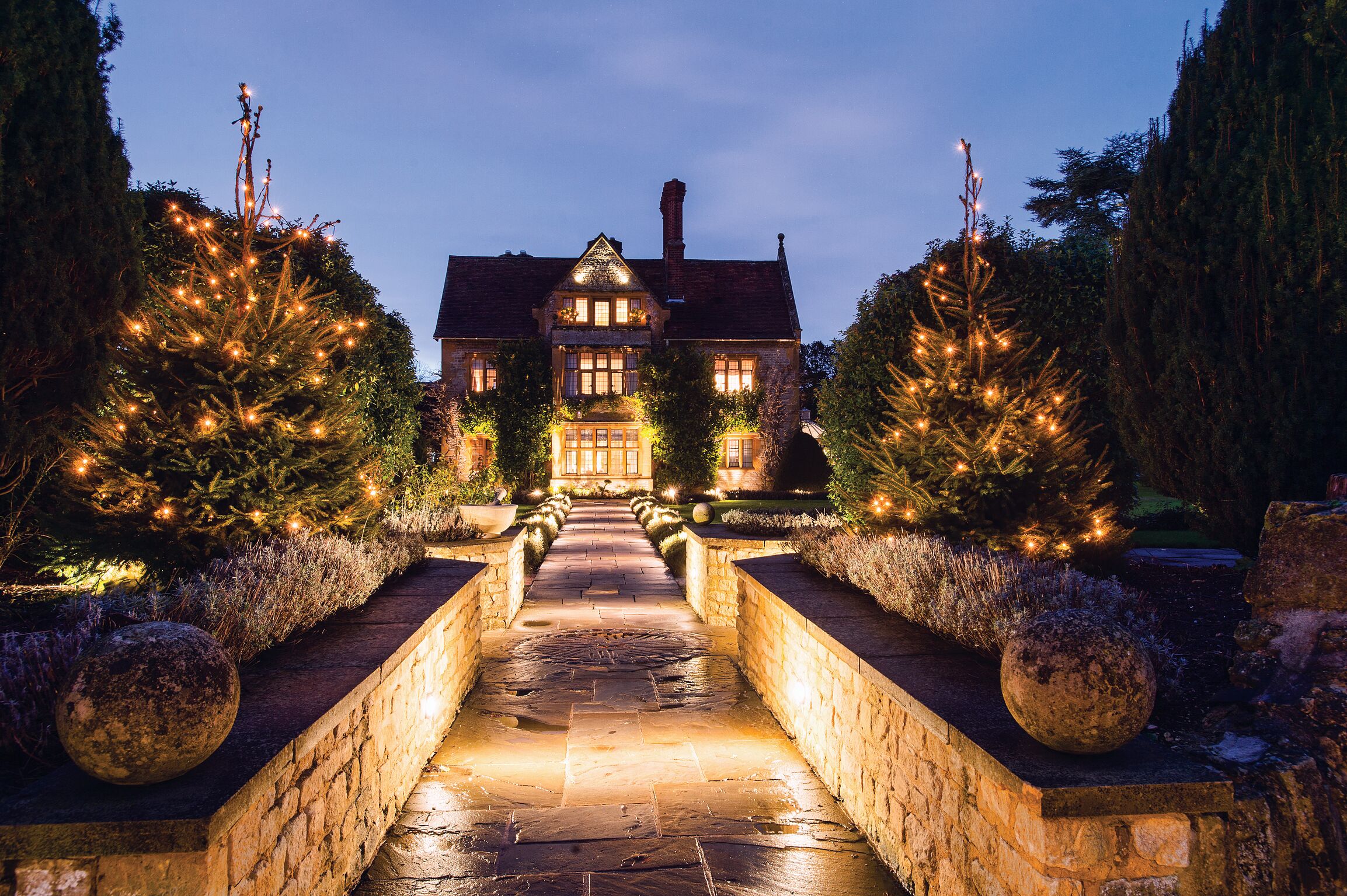
Belmond La Residencia in Deià sits at the heart of the village that Graves made famous, a sixteenth-century manor house surrounded by olive and citrus groves with views down through terraced gardens to the sea. It is a place that artists have always understood — something in the quality of the light here, the particular quality of the Tramuntana air, the sense of existing slightly outside ordinary time.
Our guide to the island in full is found in Experience a Glorious Summer in Mallorca, the Pearl of the Mediterranean
Those who wish to explore the Balearics by sea will find our Palma de Mallorca to Port Adriano superyacht itinerary → the natural companion.
For private villa journeys throughout Spain and the islands, read Exclusive Villa Journeys 2026: The Global Collection for UHNW Privacy
Menorca is quieter and more considered than its neighbour — a UNESCO Biosphere Reserve with prehistoric monuments scattered across its interior and beaches of an almost surreal clarity along its south coast. Ibiza, beneath the seasonal noise, contains an old town — Dalt Vila — of genuine medieval beauty, and pockets of the island that remain entirely unchanged. Formentera, the smallest of the main islands, is barely developed at all — a place of salt flats and wild rosemary and water of a Caribbean transparency that one does not expect to find in the western Mediterranean.
Extremadura, Castilla & Asturias — The Quiet Interior

The interior of Spain is the part that most visitors never find, and the part that those who do find it tend not to forget.
Extremadura is a vast, unhurried region of dehesa landscape — ancient managed woodland of cork oak and holm oak, spaced widely enough that light reaches the ground, across which the native grasses grow thick and the Ibérico pig roams freely on a diet of acorns that produces the finest cured ham in the world. Here too the conquistadors were born, and the Roman city of Mérida preserves a theatre that still stages performances two thousand years after it was built. It is a landscape of immense, uncrowded beauty that asks only that you slow down sufficiently to receive it.
Castilla is the heartland — the high plateau, the great medieval cities of Toledo, Segovia, Salamanca, Ávila, each enclosed within walls that have stood for centuries and each containing within them a concentration of history and art that requires not a day but a week to begin to absorb. Asturias, in the far north, is the one kingdom that was never conquered by the Moors — rugged, pre-Romanesque in its churches, green with the same Atlantic rain that feeds Galicia, and producing a cider culture of great seriousness and conviviality.
The Canary Islands — Where Europe Meets Africa

The Canary Islands sit off the northwest coast of Africa — closer to Mauritania than to Madrid — and carry in their geology and their light the evidence of their position. These are volcanic islands, formed by the same forces that built the great shield volcanoes of the Pacific, and they carry in their landscapes a drama and a strangeness that is entirely unlike anything in continental Spain.
Tenerife contains Mount Teide, a volcano of 3,715 metres that is the highest point in Spain and the third-largest volcano in the world measured from the ocean floor. The landscape around it — the Cañadas del Teide, a high-altitude caldera of extraordinary otherworldly beauty — is a UNESCO World Heritage Site and one of the most remarkable places in Europe to observe the night sky.
Lanzarote was shaped by the artist and architect César Manrique into something unique in the world — an island where development has been constrained for decades by a philosophy of aesthetic respect, where the architecture is low and white and the volcanic landscape is allowed to speak for itself. La Palma is the greenest and most dramatically forested of the islands, its Caldera de Taburiente a vast natural amphitheatre of ancient laurel forest. La Gomera, El Hierro — the westernmost point of the old world, where sailors once believed the earth ended — offer a solitude and a wildness that the larger islands have long since left behind.
To Travel Spain as It Should Be Travelled

Spain is not a country that yields itself to the itinerary assembled in haste. It requires time, curiosity, and the willingness to resist the familiar in favour of the true. The tourist routes are not wrong — they exist because the things on them are genuinely extraordinary — but they are the beginning of an understanding, not its destination.
What Sculptured Journeys offers is access to the country that exists beyond those routes — the Andalusian parador in a hilltop village where dinner is served in a room that was once a convent refectory; the private flamenco performance in a Seville courtyard for an audience of six; the dawn visit to the Alhambra before the crowds arrive, when the Nasrid palaces are lit by a light so particular and so golden that no photograph has ever quite captured it; the Galician fishing village where the chef has three Michelin stars and the dining room holds twelve people.
This is where Spain begins. Not at the airport, not on the first morning, not at the famous monument photographed ten thousand times before yours. It begins in the moment you stop looking for Spain and allow it to find you.
That is the moment we design for.
Every journey is designed exclusively for you.




.jpg)





















-002.jpg)
