Sicily: Italy's Most Culturally Layered Island
There are destinations you visit, and there are destinations that change the way you see the world. Sicily is the latter.
I have travelled extensively across Italy for more than a decade, and nothing prepared me for the feeling of arriving in Sicily for the first time. It is not simply beautiful — though it is, in ways that stop you mid-sentence. It is something older and stranger than beauty. It is the accumulated weight of every civilisation that has ever crossed the Mediterranean and decided to stay.
The Greeks built temples here that still stand. The Arabs left their geometry in the courtyard gardens of Palermo. The Normans built a palace whose mosaics rival anything in Byzantium. The Spanish left their mark on the architecture, and their influence can still be heard in the Sicilian dialect — a language that carries fragments of Arabic, Greek, French and Spanish, woven together over centuries into something entirely its own.
This is what separates Sicily from every other destination in Italy. Not its coastline, though that is extraordinary. Not its cuisine, though it is unlike anything you will find anywhere else on the peninsula. What separates Sicily is the sheer density of its history — the sense, as you walk through Siracusa or stand among the temples of Agrigento at dusk, that you are standing at the crossroads of the ancient world.
And yet Sicily is not a destination you can absorb in a single visit, or tell in a single story.
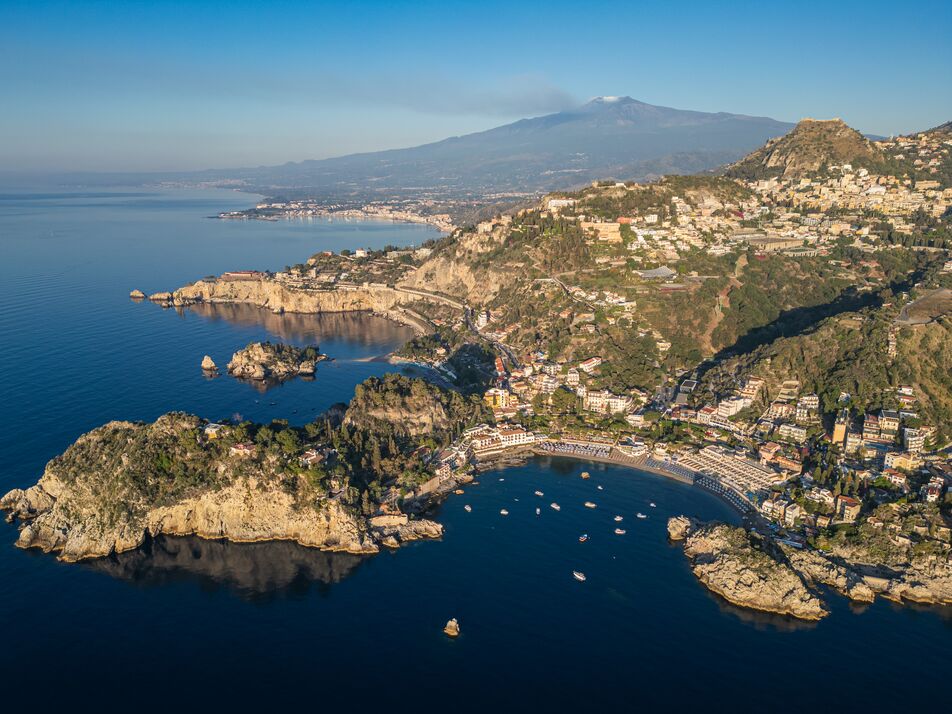
The glamour of Taormina — that extraordinary clifftop town where a perfectly preserved Greek theatre looks out over the sea, with Etna rising behind it — belongs to a completely different world than the volcanic wilderness of the mountain itself, where we take guests into private wineries carved into lava fields with naturalist guides who have spent their lives understanding this landscape. Palermo, with its Arab-Norman architecture and its chaotic, magnificent street markets, has almost nothing in common with the serene Baroque symmetry of Ragusa or the ancient quiet of Ortigia. The Aeolian Islands, scattered in the Tyrrhenian Sea north of the mainland, are a world unto themselves — best explored by private yacht, moving between anchorages at your own pace, arriving somewhere new each morning.
Sicily rewards those who approach it with intention. With the right partners, the right properties, the right guides — and, above all, with enough time to let the island reveal itself slowly — it becomes one of those rare experiences that stays with you long after you return home.
What surprises most of our clients, when we first begin talking about Sicily, is that they had never truly considered it. They knew the name. They had seen the photographs. But they had no idea. That is, perhaps, the most honest thing you can say about this island: nothing quite prepares you for the reality of it.
Taormina & Mount Etna

Perched on a clifftop above the Ionian Sea, Taormina is one of those places that earns every superlative quietly, without trying. The town itself is small and ancient — a maze of honey-coloured streets, bougainvillea-draped balconies and views that open suddenly onto the sea or the mountain depending on which direction you turn. It is the kind of place where an afternoon can disappear entirely.
At its heart is the Teatro Antico, a Greek theatre dating to the third century BC, later expanded by the Romans and still in use today. To sit in those stone tiers — watching the sky change colour over the sea while Etna rises in the distance, still breathing — is to experience something that no amount of reading quite conveys. In summer, the theatre becomes a venue for international classical music, opera and dance performances of genuine distinction. We arrange private early-morning access for guests before the crowds arrive, when the light is long and the silence is complete.
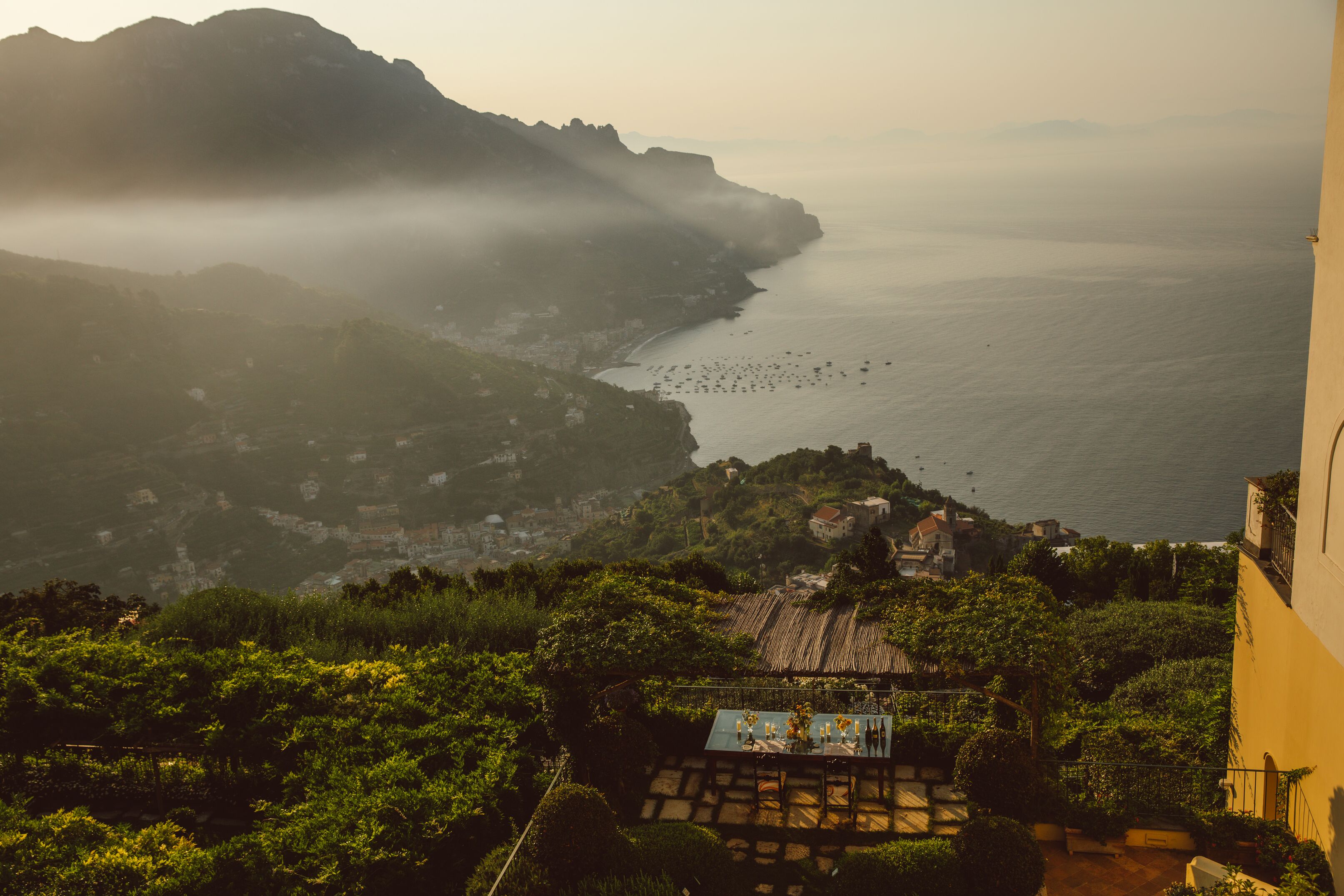
A cocktail on the terrace of the Grand Hotel Timeo, A Belmond Hotel as the afternoon fades is one of those moments that becomes a fixed point in memory. Positioned directly above the theatre with Etna framing the horizon, the Timeo has been receiving guests since 1873 — and it remains the defining address in Taormina. For those who prefer to be closer to the water, the Belmond Villa Sant'Andrea sits at the edge of the Gulf of Naxos at Mazzarò, its private beach lapped by some of the clearest water on the Sicilian coast. We move guests between the two properties as the day shifts — mornings and late afternoons up in the town, the heat of midday down at the water's edge.
Below Taormina, the bays curve around in a series of rugged, beautiful inlets best explored by private boat. A morning on the water — moving along the coastline, anchoring in a quiet bay, returning for lunch — is one of the simpler pleasures of this part of Sicily, and one of the most lasting.
Then there is Etna. Most visitors see it from a distance and leave it at that. We take a different approach. With our naturalist private guides, we move up into the volcanic landscape on the mountain's quieter flanks, visiting small family-run wineries producing wines under the Etna DOC designation — some of the most interesting bottles in Italy, grown in mineral-rich volcanic soil at altitude, largely unknown beyond the island. The experience of tasting Nerello Mascalese among the lava fields, with the crater visible above you and the sea visible below, is genuinely unlike anything else we offer in Italy. Etna is not a backdrop. It is a destination in its own right.
Palermo & the West
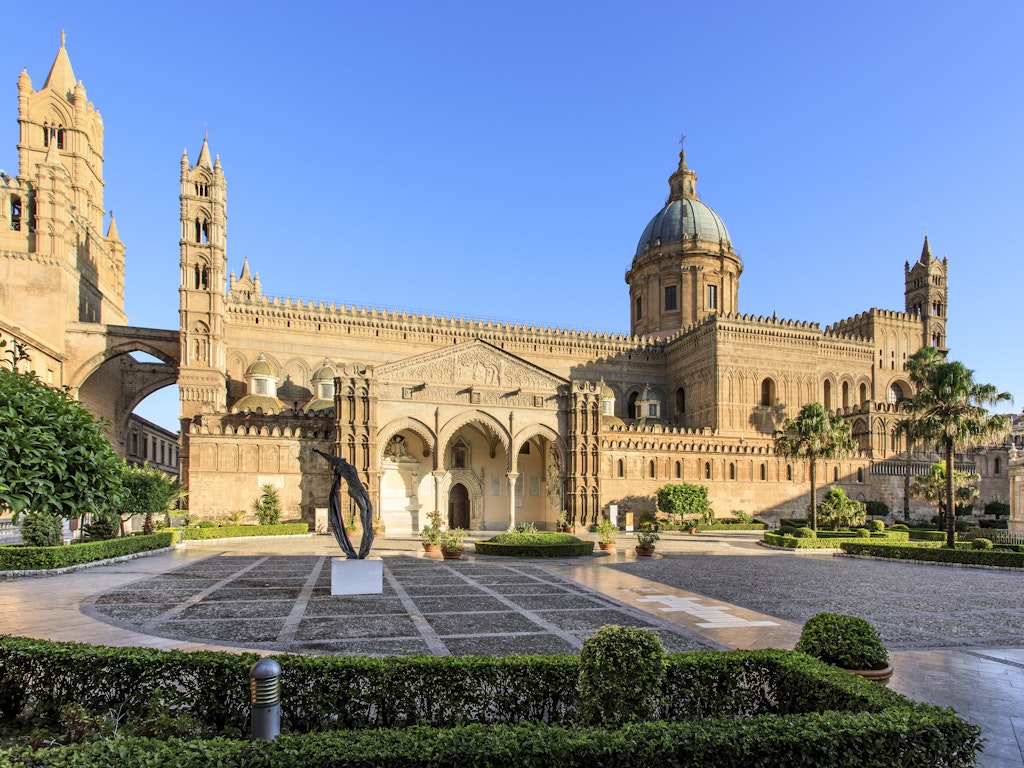
Most people arrive in Palermo not knowing quite what to expect. They leave struggling to describe what they experienced. It is that kind of city.
Palermo is not polished. It is not trying to be. It carries its history openly — in its architecture, its markets, its dialect, its food — with a confidence that comes from knowing it has been at the centre of the Mediterranean world for more than two thousand years. Arabs, Normans, Spanish viceroys and Bourbon kings have all governed this city, and each left something permanent behind. The result is an urban landscape unlike anywhere else in Italy — or indeed, anywhere else in Europe.
The Palazzo dei Normanni, the oldest royal residence on the continent, contains the Cappella Palatina, a private chapel whose golden Byzantine mosaics are among the greatest works of art produced in the medieval world. The Arab-Norman churches of the city — La Martorana, San Giovanni degli Eremiti with its five red domes — feel closer to Cairo or Damascus than to Rome. And yet this is Sicily. This is Italy. The complexity is the point.
The Ballarò market, one of the oldest street markets in Europe, is another world entirely — colour, noise, the scent of street food, vendors selling produce that has come from these same volcanic soils for generations. We accompany guests through Ballarò with local guides who know every stall, every vendor, every dish worth pausing for. It is not a comfortable, curated experience. It is not meant to be. It is Palermo as it actually is.
Villa Igiea, A Rocco Forte Hotel is a restored Art Nouveau palazzo overlooking the bay, is among the most beautifully positioned properties in the region — for those spending time in the city itself. Further west along the southern coast, the Rocco Forte Verdura Resort offers a different register entirely: wide terraces, a private beach, and the kind of calm that follows several days of absorbing Palermo's density.
West of Palermo, towards Trapani, the landscape opens into something quieter and more elemental. The salt pans of the Stagnone lagoon, stretching between ancient windmills towards the island of Mozia — a Phoenician settlement preserved almost intact — offer a completely different encounter with Sicilian history. At the right time of day, in the right light, the salt flats turn pink and copper and gold. It is one of those images that arrives without warning and stays permanently.
Siracusa & Ortigia
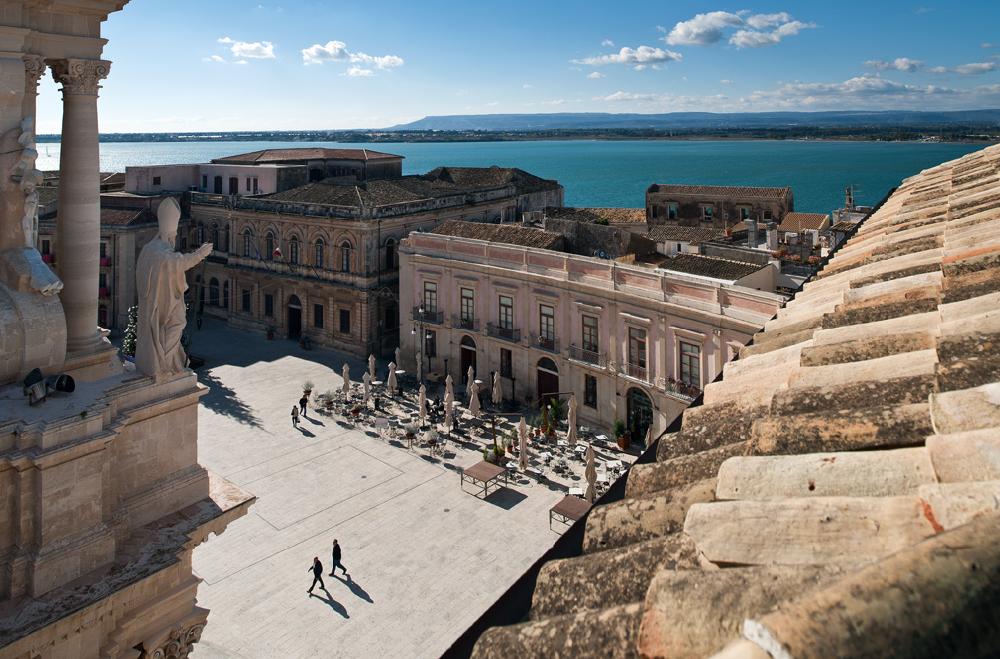
Siracusa is where Sicily's ancient history feels most present, most legible. Founded by Greek colonists from Corinth in 734 BC, it became one of the most powerful cities in the ancient world — rivalling Athens, defeating Carthage, producing Archimedes. Walking through its streets is to move through layers of time so compressed they become almost vertiginous.
The heart of the city is Ortigia, a small island connected to the mainland by two bridges and largely unchanged in its street plan since antiquity. The Duomo di Siracusa is one of the most extraordinary buildings in Italy — a fifth-century BC Greek temple to Athena absorbed, column by column, into a Baroque cathedral. The ancient columns are still visible along the nave. It is an image of cultural continuity so complete it almost defies description.
The Piazza del Duomo itself, golden in the late afternoon, is one of the finest urban spaces in southern Italy. The fountain of Arethusa, fed by a freshwater spring that emerges at the edge of the sea, has been here since before the city was founded. These are not ruins. They are places still entirely alive.
We stay in small, beautifully restored palazzi in Ortigia — properties that understand the neighbourhood's scale and character, where a private courtyard and a careful breakfast matter more than a lobby. The intimacy of the island suits a different pace. Siracusa asks you to slow down, to look carefully, to take the time. Guests who do are consistently among those who speak of it longest afterwards.
The archaeological park on the mainland — the Teatro Greco, the vast Roman amphitheatre, the Ear of Dionysius — is best visited at opening, before the heat rises and the groups arrive. We arrange early access and guide the visit in a way that transforms ruins into narrative.
Agrigento & the Valley of the Temples
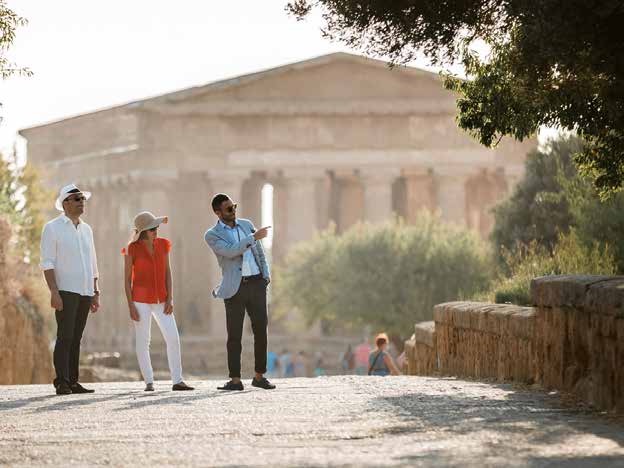
There are few places in Sicily — few places in the world — that produce the effect of the Valley of the Temples at the right hour of the day.
Agrigento's remarkable complex of Doric temples, built by Greek colonists in the fifth century BC, stands on a ridge above the southern coast of Sicily, looking out towards Africa. The Temple of Concordia is one of the best-preserved Greek temples in existence — more complete, in some respects, than many of those in Greece itself. At dusk, as the stone turns from white to gold to amber, the scale of what the ancient world was capable of becomes briefly, fully comprehensible.
This is not a site we rush. For families, we organise private picnics among the almond and olive trees that grow between the temples — a lunch laid out in the shade while a guide tells the story of the city that built all of this and the civilisation it belonged to. For those with children, it is often described as the moment that history stopped being an abstraction. For those without, it is simply one of the great experiences Sicily offers.
Agrigento itself is a working Sicilian city, not a tourist destination in the conventional sense, and we think that is part of its value. The people here have lived alongside this extraordinary inheritance for their entire lives. It gives the place a quality of the genuine that is becoming harder to find.
As a day journey from either the east or west of the island, paired with a private driver and a well-considered route, Agrigento works beautifully within a longer Sicily itinerary. It also rewards an overnight stay — particularly in the hours before the site opens each morning, when you can have it almost entirely to yourself.
Ragusa & the Baroque South
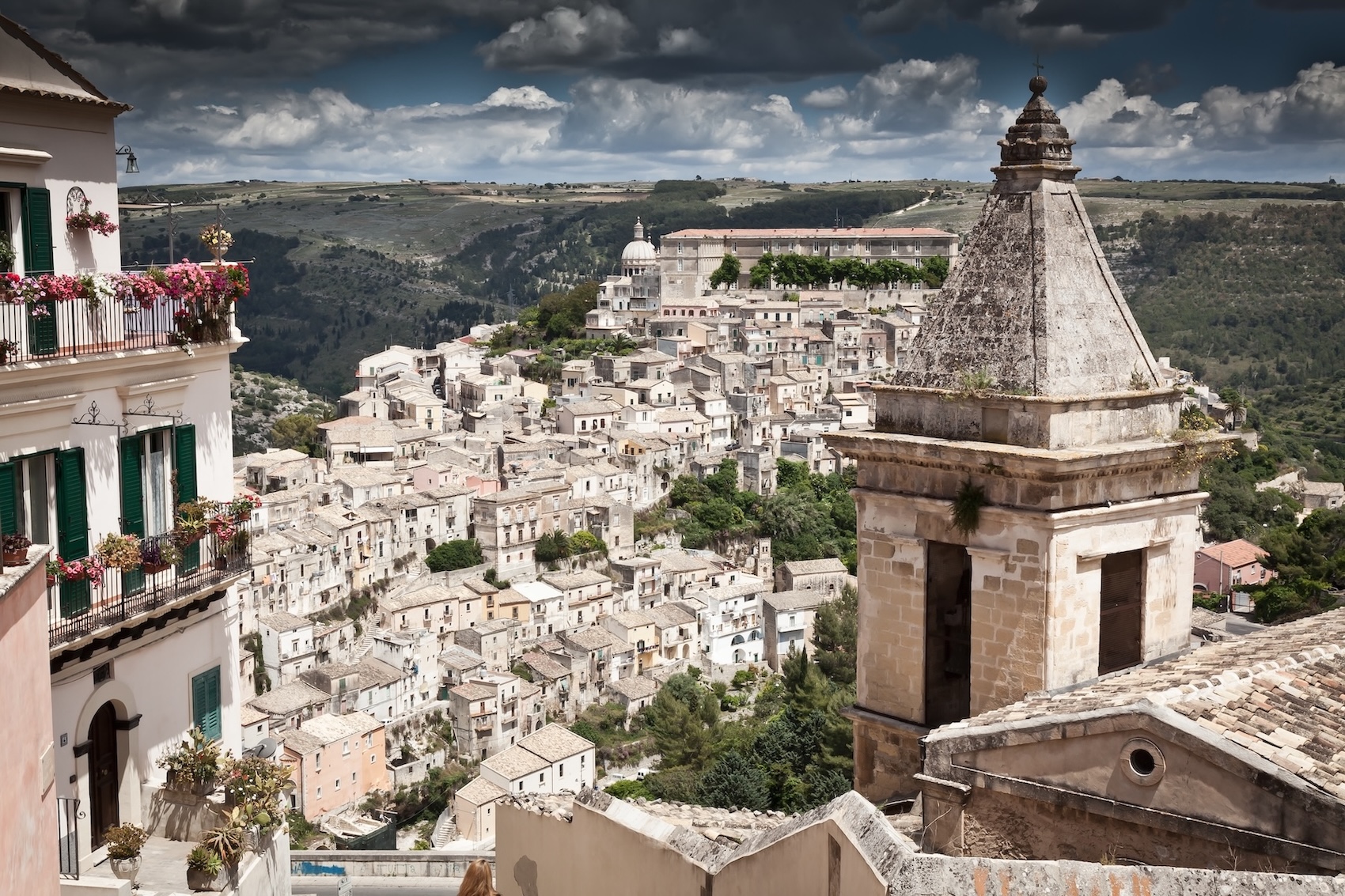
The south-eastern corner of Sicily is the part of the island that most surprises first-time visitors. After the drama of Etna and the density of Palermo, the Baroque hill towns of the Val di Noto feel like a discovery — quieter, more contemplative, completely different in character from anything else on the island.
Ragusa Ibla — the ancient lower town, rebuilt entirely after the 1693 earthquake in a single sustained act of Baroque architecture — is one of the most beautiful urban environments in Italy. The streets curve and descend through gardens and staircases, past churches of extraordinary elaboration, to a belvedere that looks out over a valley of olive trees and limestone gorges. It has the quality of a place that has been left largely alone to be itself.
Noto, an hour to the east, was rebuilt on an entirely new site after the earthquake and represents perhaps the most complete example of Baroque town planning in Europe. The main corso, lined with honey-coloured palaces whose balconies are supported by carved figures of extraordinary invention, is best walked in the early morning or the late evening, when the stone glows and the crowds have thinned.
We work with small, considered properties in this part of Sicily — converted masserie and restored palazzi whose owners understand the landscape and the culture — rather than large resort hotels. The south-east is a part of Sicily that suits a slower itinerary: private cooking experiences, drives through the Iblean plateau to visit small producers of the region's exceptional olive oil and cheese, mornings spent in complete quiet.
The cuisine here is its own subject. Arancini, caponata, pasta alla Norma, fresh seafood caught that morning — Sicilian food carries the same multicultural complexity as the island's architecture, with Arab influences visible in the use of sweet and sour, saffron and raisins, alongside the simplicity of the best Italian cooking. A long lunch in the south-east, in the right setting, with the right wine, is one of those experiences that becomes a reference point for everything that comes after.
Trapani & the Salt Pans
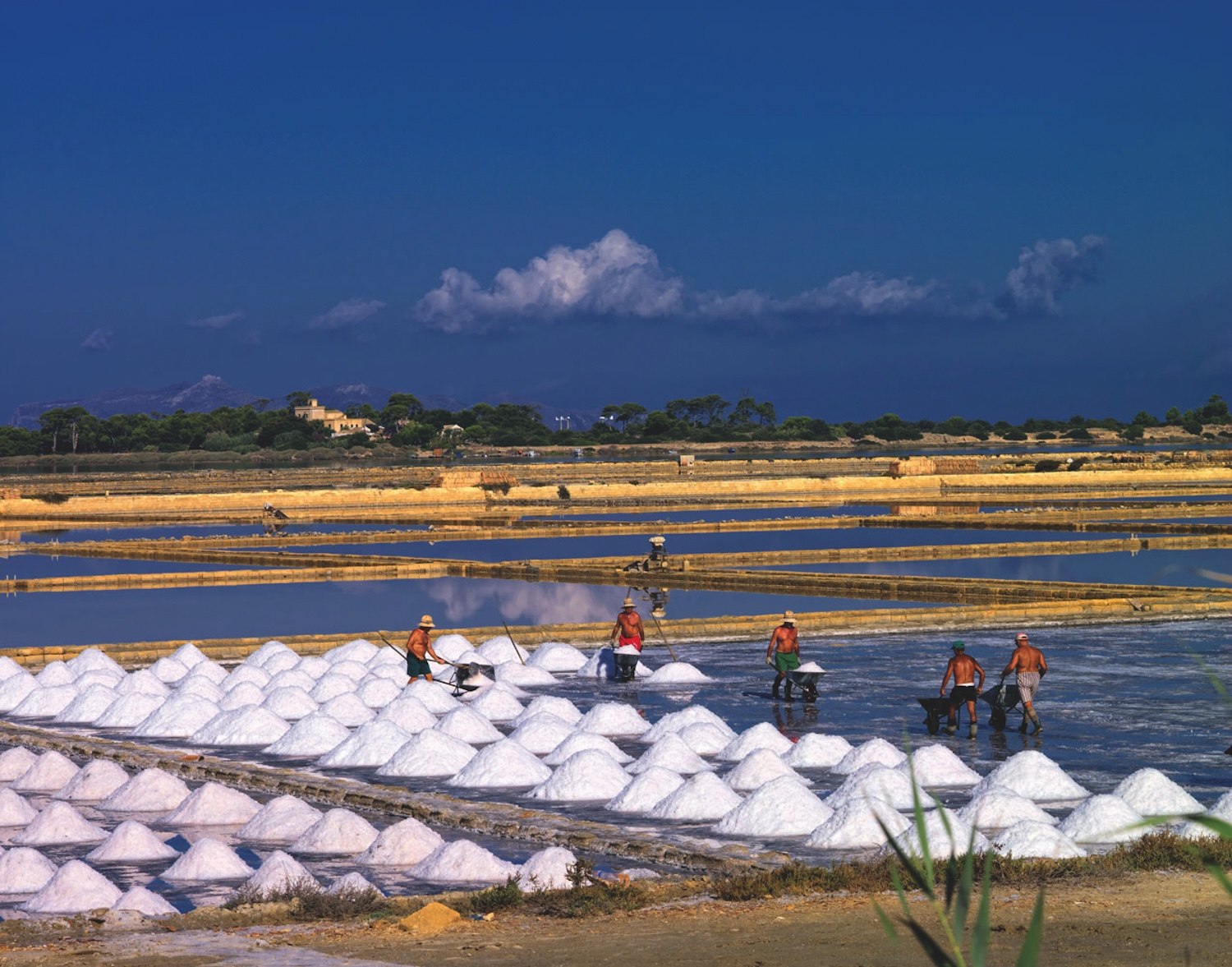
Western Sicily has a different quality of light. Flatter, more open, the landscape stretching towards the sea with a clarity that feels almost North African. This is not coincidence — Trapani sits closer to Tunis than it does to Rome, and the history of this coastline reflects that geography in every detail.
The city of Trapani itself is a working port, elegant in a quiet way, with a historic centre of narrow streets and faded palazzo facades that rewards an afternoon on foot. The real draw, however, is the coastline to its south — the Stagnone lagoon, where ancient salt pans still produce sea salt in the traditional way, and where the silhouettes of restored windmills stand against the water at the hour when the light is most extraordinary.
Mozia, a small island in the lagoon accessible only by boat, was a Phoenician colony established in the eighth century BC and abandoned after its destruction by the Syracusans in 397 BC. The site has never been built over. The excavations are among the most evocative in Sicily — a civilisation interrupted, preserved in the shallow water. We visit by private tender, with an archaeologist who has worked the site for years.
The Egadi Islands — Favignana, Levanzo, Marettimo — lie just offshore from Trapani and are among the least visited and most beautiful archipelagos in the western Mediterranean. We reach them by private charter, anchoring in bays where the water is the colour of pale glass and the only sound is the sea. Levanzo contains Neolithic cave paintings of extraordinary delicacy. Marettimo, the furthest island, is almost entirely uninhabited.
A Note on How We Travel Sicily
You can fly into Palermo or Catania, depending on where your journey begins — and the choice of entry point shapes the itinerary in interesting ways. We plan every Sicily journey as a fully private experience: private drivers, private guides, private access wherever it can be arranged. There are no coaches, no fixed departure times, no itineraries that belong to anyone other than the people travelling them.
The island is large enough to reward multiple visits and varied enough to offer a completely different experience each time. We have clients who return annually, focusing each time on a different part of Sicily or a different mode of travelling it — by land one year, by sea the next. The Aeolian Islands and Pantelleria, each with their own distinct character, are covered in their own dedicated guides.
If you have not yet considered Sicily, we would gently suggest that this may be the moment. It is, without question, the most culturally layered destination in Italy — and one of the most extraordinary places in the Mediterranean world. The only thing it asks of you is time.




.jpg)