
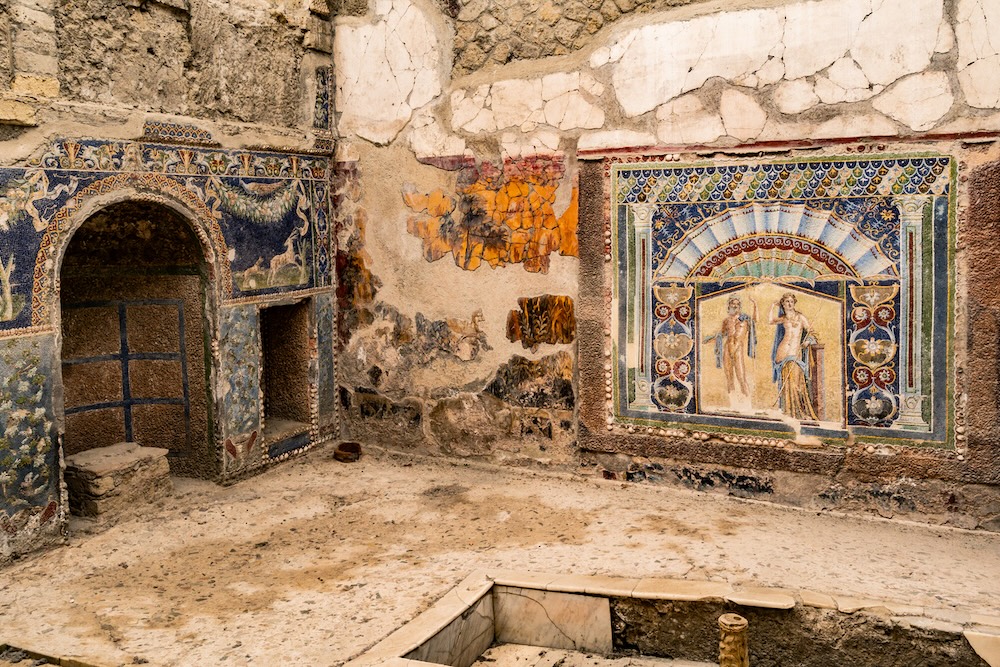
What the Ash Preserved
Herculaneum, the Villa of the Papyri, and the scroll that three centuries of scholarship could not open
In a laboratory in Grenoble, on the twenty-fifth of June 2026, a scroll that had not been read since antiquity yielded its text. No knife was taken to the surviving roll. No further fragment had to be sacrificed. The document — a philosophical treatise in Greek, carbonised in the eruption of Vesuvius in 79 AD and sealed within the volcanic deposits that engulfed Herculaneum — was reconstructed column by column through high-resolution phase-contrast X-ray micro-tomography, computational unrolling and machine-learning ink detection. The announcement came from the Vesuvius Challenge, following scanning at the European Synchrotron Radiation Facility in Grenoble and work carried out in collaboration with the National Library of Naples, which safeguards the Herculaneum papyri. The scroll in question is catalogued as PHerc. 1667.
It is easy to reduce this to a headline about technology. It is more accurate to understand it as the culmination of something that began in the eighteenth century, in a garden suburb of ancient Herculaneum, when workmen sinking a well shaft through compacted volcanic rock struck the edge of a floor.
The Library Beneath the Hill
The Villa of the Papyri is unlike any other Roman site yet excavated. Its name derives not from its mosaics, its sculpture garden, or the extraordinary bronze portraits recovered from its rooms — though each of those would have been sufficient to define a lesser site — but from its library. When Bourbon excavators tunnelled through the hardened volcanic material in the eighteenth century, they recovered some eighteen hundred fragments of ancient papyrus scrolls, thought to represent perhaps eight hundred original volumes, carbonised and compressed into forms resembling burnt wood. Nothing comparable survives from another large-scale library of the Greco-Roman world. The texts deciphered to date are predominantly works of Epicurean Greek philosophy, many by Philodemus of Gadara, an Epicurean philosopher active in the first century BC. The precise owner of the villa is not known. Its library strongly connects the house with the circle of Lucius Calpurnius Piso Caesoninus, father-in-law of Julius Caesar, and the Piso family remains the leading scholarly association.
The physical act of recovery proved, for generations, perilous for the papyri themselves. Early attempts were often ruinous: some rolls were cut vertically, and layers could be scraped away and destroyed as they were transcribed. From 1753, Padre Antonio Piaggio developed a painstaking mechanical method that used threads attached to the outer surface to lift and unroll the papyrus little by little, preserving texts that might otherwise have been inaccessible but still exposing an extraordinarily fragile material to the risks of physical opening. Contemporary accounts also indicate that, before the finds were understood, some carbonised pieces were mistaken for burnt wood or branches and may have been discarded. What could be opened was studied and transcribed with varying degrees of success. Hundreds of rolled fragments remained too fragile to risk opening at all.
PHerc. 1667 and the Vesuvius Challenge
The Vesuvius Challenge, launched in 2023, brought together academic institutions, computing scientists and independent researchers in an open-prize framework designed to accelerate the virtual reading of Herculaneum’s still-rolled papyri. The method that produced the June 2026 result used high-resolution phase-contrast X-ray micro-tomography acquired on the BM18 beamline at the European Synchrotron Radiation Facility in Grenoble, together with improved computational unrolling and machine learning. The scans capture the densely wound internal structure of the carbonised papyrus; computational methods reconstruct and flatten the surviving writing surface, while machine-learning models recover ink signals that are exceptionally difficult to distinguish from the carbonised substrate. Papyrologists then review and transcribe the recovered text.
PHerc. 1667 is itself only the surviving core of a larger roll. Earlier attempts to open it physically — in the nineteenth century and again in 1969 and the 1980s — destroyed its outer layers, leaving a compact inner portion about eight centimetres high from an original roll estimated at roughly nineteen to twenty-four centimetres. What the 2026 announcement confirmed was the complete virtual reconstruction and reading of the preserved writing surface of that surviving core — roughly 1.4 metres of papyrus containing the lower parts of about twenty-two columns of Greek text. The precision of that result, and the fact that the surviving rolled portion did not have to be physically opened to produce it, represent a genuinely significant threshold in the history of ancient studies.
The recovered text is a philosophical treatise concerned with ethics and human behaviour. The evidence points to a Stoic work: the final preserved column names Aristocreon, nephew and disciple of Chrysippus, the third head of the Stoic school, while the language and themes place the text within a Stoic context. The author and title remain unknown. The Vesuvius Challenge dates the work to the second century BC, while some collaborating research institutions allow the possibility of the late third century BC. What is certain is that a substantial text previously unavailable to scholarship can now be read continuously across the surviving roll. It is new knowledge recovered from an ancient work that had effectively disappeared.
What Herculaneum Preserves That Pompeii Lost
Herculaneum died differently from Pompeii. Pompeii was subjected first to a prolonged fall of pumice and ash, under whose accumulating weight many roofs collapsed, before later pyroclastic currents reached the city. Herculaneum, much closer to Vesuvius, was overwhelmed by successive hot pyroclastic surges and flows and ultimately buried beneath a far deeper mass of volcanic material. Those conditions carbonised wood, papyrus and other organic matter and then sealed much of the town in an oxygen-poor environment that inhibited further decay. Portions of upper storeys survived, as did wooden furniture and architectural elements, food remains and other materials rarely preserved on this scale. The library at the Villa of the Papyri endured not despite the eruption but, in a particular and ironic sense, because of the conditions it created.
The excavated site today occupies only a fraction of ancient Herculaneum. The Villa of the Papyri — one of the most imposing private residences known from the Roman world, with a frontage of more than two hundred metres — still lies largely buried beneath volcanic material and the modern city of Ercolano. It was extensively mapped through Bourbon tunnels in the eighteenth century, while only limited areas have since been exposed in open-air excavation. What has been recovered is exceptional. What remains inaccessible may be more so. The papyri found in the eighteenth century appear to include the working philosophical library of Philodemus, or at least its philosophical portion. Scholars therefore continue to consider the possibility that further papyri — potentially including books of other genres and in Latin — remain in unexcavated parts of the villa, though the existence of a separate 'main library' has not been established.
The Park and Its Deeper Layers
The Herculaneum Archaeological Park normally opens Monday to Sunday, with standard annual closures on 1 January and 25 December and extended hours from 16 March through 14 October. Visitors move through the excavated town on a circuit that is, by the standards of major archaeological sites, genuinely intimate — the scale is such that what stands here can be read as a neighbourhood rather than a ruin field, the streets narrow enough to cast shadow, the walls high enough to convey proportion. The standard circuit is, in itself, among the more affecting experiences available in the Bay of Naples. The Villa of the Papyri and the Ancient Theatre are not currently accessible as part of the ordinary visitor route: the villa is closed for excavation, extraordinary maintenance, water-management, slope-restoration and accessibility works, while the Theatre is closed for urgent extraordinary maintenance. No reopening date has been announced for either.
What the Park does offer, and what has developed in meaningful ways over the course of 2026, is controlled access to areas outside the standard visitor route. During the European Archaeological Days in June, for example, the private thermal complex of the Casa dell’Albergo was exceptionally opened and visitors were admitted to the active restoration site of the Suburban Baths in groups capped at fifteen. The Park subsequently resumed accompanied visits to the Suburban Baths on specified Saturdays from June through December 2026, again with limited group sizes and Park staff accompanying visitors. This is not a standing private-client privilege: it is programme-led, capacity-controlled access determined by the Park and by conservation requirements. That distinction is precisely what gives it value.
The Park’s 2025–2030 management plan anticipates further development of this approach, including periodic reopening of the Ancient Theatre’s underground route and the continuation of programmes that bring visitors into excavation and restoration contexts. The honest framing of that prospect is that it is conservation-dependent and programme-led. The access exists, and new opportunities can emerge, but they cannot be guaranteed on demand or scheduled independently of the Park’s own processes. Understanding when and through whom these layers become legitimately available — and being positioned to move when they do — is the appropriate posture for any serious engagement with Herculaneum.
A Considered Return
The National Library of Naples, the Biblioteca Nazionale di Napoli Vittorio Emanuele III, is where PHerc. 1667 is held and where, on 25 June 2026, the breakthrough was presented during the international conference The Eternal Library. The library’s Officina dei Papiri Ercolanesi — the specialist section devoted to the Herculaneum papyri — is the custodian of the collection and an essential centre for its study. Naples, for anyone approaching Herculaneum seriously, is not merely the logistical gateway to the site: it is the other half of the story. The scrolls came here, and one of the most consequential new chapters in their reading was announced here in 2026.
Herculaneum rewards the kind of attention that most travel does not create the conditions for. The site is compact, which is sometimes mistaken for simplicity. It is, in fact, dense — dense with specificity, with the material record of individual lives, with questions that remain genuinely open. The scroll announced in June is the most dramatic recent instance of the principle that has always governed this site: that what the ash covered, it also kept. The excavation is not complete. The reading is not complete. What Herculaneum holds in reserve is, by any serious reckoning, still more than it has yet given up.
FREQUENTLY ASKED QUESTIONS
Q: What was discovered at Herculaneum in 2026?
A: On 25 June 2026, the Vesuvius Challenge announced the first complete virtual unwrapping and end-to-end reading of the preserved writing surface of a rolled Herculaneum papyrus, PHerc. 1667, held at the National Library of Naples. Using high-resolution phase-contrast X-ray micro-tomography at the European Synchrotron Radiation Facility in Grenoble, computational unrolling and machine-learning ink detection, researchers recovered roughly 1.4 metres of papyrus containing the lower parts of about twenty-two columns of Greek text without physically opening the surviving core.
Q: What does PHerc. 1667 contain?
A: PHerc. 1667 contains a philosophical treatise on ethics and human behaviour. The evidence points to a Stoic work, and the final preserved column names Aristocreon, nephew and disciple of Chrysippus. The author and title remain unknown. The Vesuvius Challenge dates the work to the second century BC, while some collaborating research institutions allow the possibility of the late third century BC.
Q: Can you visit the Villa of the Papyri at Herculaneum?
A: The Villa of the Papyri is not currently accessible to visitors. It is closed for excavation, extraordinary maintenance, water-management, slope-restoration and accessibility works, with no reopening date announced. The Herculaneum Archaeological Park remains open on its normal schedule and, at certain times, offers controlled access to other sensitive areas — including accompanied visits to the Suburban Baths on specified 2026 dates — according to the Park’s own conservation and visitor programmes.
Q: How is Herculaneum different from Pompeii?
A: Herculaneum and Pompeii were affected differently by the eruption of Vesuvius. Pompeii experienced a prolonged fall of pumice and ash before later pyroclastic currents, while Herculaneum was overwhelmed by hot pyroclastic surges and flows and buried beneath a much deeper volcanic deposit. At Herculaneum, those conditions carbonised and sealed wood, papyrus, food and other organic materials in an oxygen-poor environment, contributing to exceptional preservation. Portions of upper storeys and wooden architectural elements survive, and the excavated area is considerably smaller than Pompeii’s, giving the site a distinctive intimacy and legibility.
Private by nature. Extraordinary by design.







.jpg)





























-002.jpg)
