-002.jpg)
Venice: A Private Portrait
There is a Venice that most travellers carry home: the Rialto at noon, St. Mark's Basin at dusk, the Grand Canal from a crowded vaporetto. It is not a false Venice — those images are real, and the city earns every one of them. But it is Venice as threshold, and most visitors never cross it.
Dorsoduro sits at the southwestern edge of the city, draped along the bend where the Grand Canal meets the Giudecca Canal. It is quieter here — not by accident, but by nature. The streets narrow into passages barely wide enough for two people to pass without turning sideways. Laundry crosses high above the light. The bakers and the glassware restorers and the mask-makers who supply the city's theatrical life have their workshops here, in courtyards with unlabelled doors — and in other workshops behind those, artisans are shaping glass in the old manner, pressing sheets of marbled paper, carving the wooden oarlocks — the forcole — that fit the gondolier's stroke as precisely as a last fits a shoe. Across Venice, in workshops from Santa Croce to the outer islands, other crafts continue in parallel: textile weaving on looms whose design has not changed in three centuries, mask-making for the theatrical and the ceremonial, bookbinding in the old manner. On a cold November morning, walking the Fondamenta Zattere with the lagoon flat and pewter-grey to the south and the Dominican church of the Gesuati throwing long shadows across the stones, it is possible to feel, briefly, that Venice belongs to no one — least of all to tourism.
This is where the journey begins. Not at the arrivals pontoon. Not at the famous landmarks, which every operator in Europe can route a guest past. But here, in the overlooked corners of a city that rewards only sustained attention.
A Relationship Built Over Decades
There is a campo in Dorsoduro that is wrong in summer — too bright, too open, the shadows insufficient — and right in November, when the stone holds the cold and the light comes low from the south across the lagoon. There is a palazzo courtyard whose custodian, after years of acquaintance, will occasionally agree to an hour inside. There is a particular hour at which the Rio della Salute empties of its morning traffic and the water stills, and the right thing to do is nothing except stand at the edge of it. Melissa Martin founded the company originally as Italian Allure Travel — for the majority of its history, a specialist in Italy and in the particular quality of life that Italy, more than almost any other country, makes available to those who know how to find it. As the company grew and its reach extended, it became SCULPTURED JOURNEYS; but the relationship with Venice predates the name change, and it is the foundation on which everything else was built. She has returned to this city year after year long enough to know all of these things — not as facts catalogued somewhere, but as the accumulated knowledge of a relationship. That is a different order of familiarity from anything that can be assembled before a first visit.
This is what the company was built on: a sustained, personal, deeply held familiarity with the places we take guests, of which Venice is perhaps the most layered example. A Venice assembled before a first visit is not the same city.
What this means in practice is both simple and significant. When a guest moves through Venice with us, the choices behind each moment — where to be, and when, and in what manner — come from the same accumulated knowledge that informs how an old friend might show you their city: with candour, with specificity, with a willingness to say that this particular morning calls for stillness rather than movement, for the back canal rather than the main waterway, for silence rather than narrative.
On Water, Privately
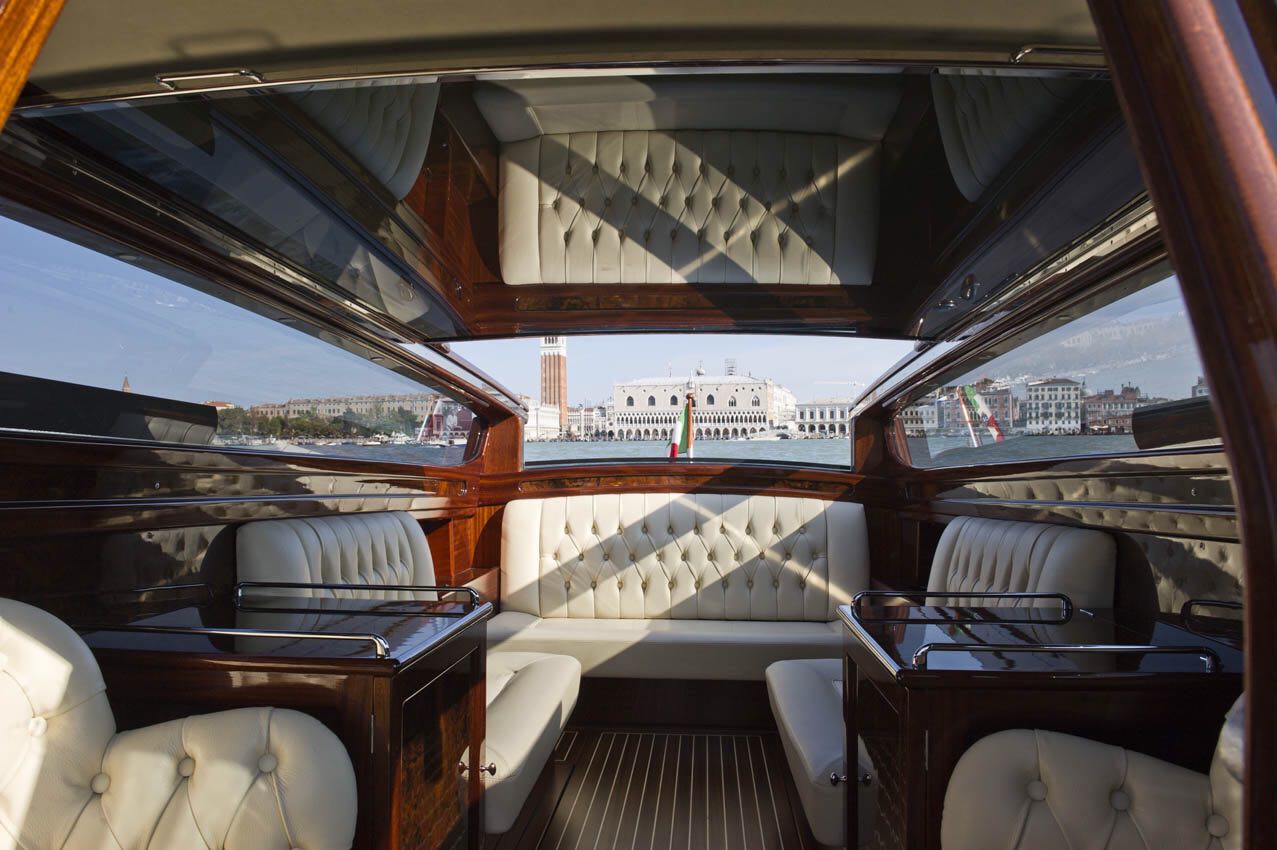
Venice is, at its most elemental, a city of water — and water in Venice is not a backdrop but a medium, a means of orientation, a way of encountering the city that changes entirely depending on how you are moving through it. The difference between the public waterbus and a privately chartered vessel is not merely one of comfort. It is a difference in what the city shows you.
A privately chartered luxury limousine boat, moving at the pace its pilot chooses, can take guests through the inner lagoon by a route that the grand waterway never reveals: past the walled gardens of monasteries whose grounds are otherwise inaccessible, along waterways that have no commercial infrastructure and no reason to expect visitors, to the northern islands where the light in autumn behaves differently than anywhere else in the Mediterranean world. Every vessel, every crossing, every hour on the water is arranged on an exclusive-use basis — there are no shared crossings, no other passengers, no programme imposed by someone else's timing.
This is not a luxury flourish. It is the structural condition for genuine discovery. Venice cannot be pressed. It opens at its own pace, to those who approach it with enough time and enough quiet.
The same privately chartered boat that moves guests through the inner city can carry them northward across the lagoon to where the islands slow everything down further still. Burano announces itself in colour — the painted facades of its houses, each a different shade of ochre, terracotta, cobalt, and sage, are, according to local legend, a record of fishermen marking their homes to find them through the fog — though documented sources trace the practice to property-boundary marking. The pleasure of being there lies in staying beyond the first impression: the quieter canals away from the main fondamenta, the fishing boats at rest, the pace of an island that retains the texture of a working fishing community alongside its considerable draw for visitors. A small bridge leads directly to Mazzorbo, a larger, much calmer island that most visitors do not reach. There, within a walled vineyard tended by Venissa, grows Dorona di Venezia — the indigenous grape variety of the lagoon, cultivated on this island in a manner that connects the glass in your hand to the salt water and the particular light of this stretch of the Adriatic. To taste it in that walled garden, with the lagoon just beyond the wall and the city a dim line on the horizon, is to understand something about Venice that a museum visit approaches from a different angle entirely.
The same boat continues, on occasion, to Murano — an island whose relationship with glass has defined it for more than seven centuries. The Murano that most visitors encounter is the commercial circuit: factory showrooms, demonstration workshops, and the familiar circuit of commercial glass production. It bears little resemblance to the island we know. Our access to Murano runs through long-standing relationships with the historical glass houses whose work is collected by major international museums, installed in royal palaces and monuments, and commissioned by some of the most significant private residences in the world. These are makers whose names appear in no commercial literature and whose studios receive no casual visitors. We arrange private showings with the master artisans themselves — exclusive viewings of work in progress or held in archive, and private purchasing arranged directly with the makers, without the intermediary of the commercial floor. Murano encountered this way is not a detour from the journey. It is one of the most concentrated encounters with living Venetian craft the lagoon offers.

The Three Properties
The question of where to stay in Venice is not merely a matter of accommodation. It is a matter of position — of what the city looks like from where you wake, and what is within reach the moment you step outside.
The Gritti Palace, A Luxury Collection Hotel, occupies a fifteenth-century palazzo directly on the Grand Canal, at the point where the canal bends south toward the Salute. It has been the quiet address of discretion for generations — a building whose scale and restraint communicate more than any statement could. From its terrace at dusk, with the palazzi of the opposite bank losing their colour slowly and the gondolas drifting beneath, Venice assembles itself into something very close to the image it has always held in the European imagination. The Gritti is for guests who want Venice as immersion — close, constant, entirely on their terms.

Aman Venice occupies a palazzo on the same canal — the Palazzo Papadopoli, completed in the mid-sixteenth century and attributed to Giangiacomo dei Grigi — though its character is entirely different. The Aman sensibility, applied to a palazzo of this scale and provenance, produces something singular: a stillness inside the city that feels almost architectural. The piano nobile retains frescoes by Giambattista and Giandomenico Tiepolo, executed around 1750 — including "The Charlatan" and "The Minuet" — and the rooms hold their height and their silence in equal measure. The private garden, reached through tall wooden doors, and the views from the upper rooms over the water make this the property for guests whose Venice is contemplative rather than immersive.

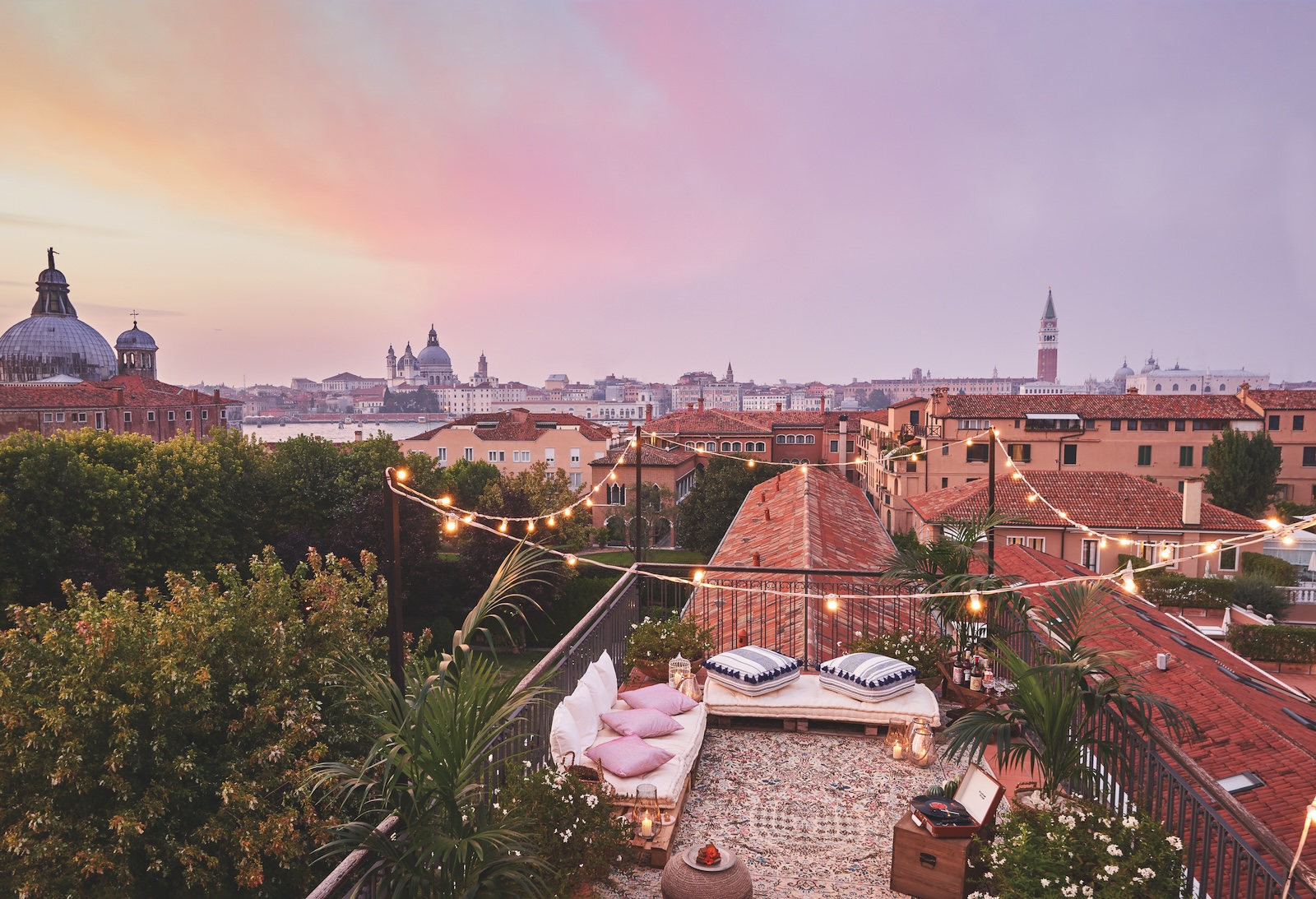
Hotel Cipriani, A Belmond Hotel, occupies a different position altogether — on the Giudecca, separated from the main body of Venice by a narrow channel, reached by private launch. That separation is, paradoxically, its greatest quality. From the Cipriani's gardens and terraces, Venice presents itself as a view — the domes of the Salute, the campanile of San Marco, the whole compressed skyline of a city that from this vantage appears to float, as it claims to. Guests staying here inhabit a distinct relationship with the city: close enough to be in it within minutes, far enough to recover from it completely.

The choice between these three properties is never incidental. We discuss it with genuine care, because the property shapes the entire arc of the journey — what is possible, what is proximate, and what the city will feel like at the end of a day spent inside it. Our relationships with all three have been built over years — a depth of connection that affects how rooms are assigned, how arrivals are handled, and what becomes quietly possible during a stay. These are not transactional connections. They are the accumulated result of conducting journeys at a level these properties recognise.
Access, and What It Requires
Venice's cultural institutions — the churches, the civic buildings, the private foundations, the archives — operate on their own terms. Some are open by appointment. Some require introductions. Some require the kind of long-standing familiarity that a first-time visitor, however well-resourced, simply cannot present. The Basilica di San Marco after the public hours close — the mosaics read entirely differently in the hush of an empty nave, the gold ground of the ceiling acquiring a depth that the daytime crowds, and the noise of them, work against. La Fenice, one of the most consequential opera houses in European history, can be experienced not as a tourist landmark but from within its programme, in the company of someone who understands what is on the stage and why it matters. The interiors of palazzi still held by the families that built them — spaces whose owners can describe the rooms as a home and a history, not as a monument — require the kind of long-standing personal familiarity that no directory can provide. The studios of Venetian artisans working at the highest level are the same: accessible through relationship, not through general enquiry.
We do not publish a list of access points. The specificity of what is possible for any given guest depends on the timing of their journey, the nature of their interests, and the particular conversations that follow from having been present in this city across a very long period of time. What can be said is that the Venice available to guests travelling in this way is a substantially richer one, and that the difference is not one of money but of relationship.

The Biennale, and the City in Exhibition
The Art Biennale is among the reasons Venice rewards return visits so specifically. When the International Art Exhibition comes to the city — as it does periodically, drawing curators, collectors, and artists from across the world — it adds a layer of contemporary depth that transforms what might otherwise be a familiar programme into something substantially new. The current edition is the 61st International Art Exhibition, titled “In Minor Keys,” running across the Giardini and the Arsenale until 22 November 2026, and extending through venues and palazzi distributed throughout the city. It is, in scale and ambition, one of the most significant international exhibitions of contemporary art, and in 2026 it carries a particular weight: the exhibition was conceived by Koyo Kouoh, appointed curator of the 61st International Art Exhibition in December 2024, who passed away in May 2025, before the exhibition opened. La Biennale di Venezia carried out her exhibition as she conceived and defined it, realised by the curatorial team she had selected.
In Biennale years, we arrange a private, considered engagement with the exhibition — not the full circuit in a single day, which reduces it to logistics, but a sequenced approach that gives particular exhibitions and national pavilions the time they require. The Arsenale alone, moving through the industrial water-gates of a former shipbuilding complex the size of a small town, demands unhurried attention. The city outside, seen between buildings and between conversations, becomes part of the experience. Whenever the Biennale is in session, this is the manner in which we recommend meeting it.
Carnival, and the Return of the Mask
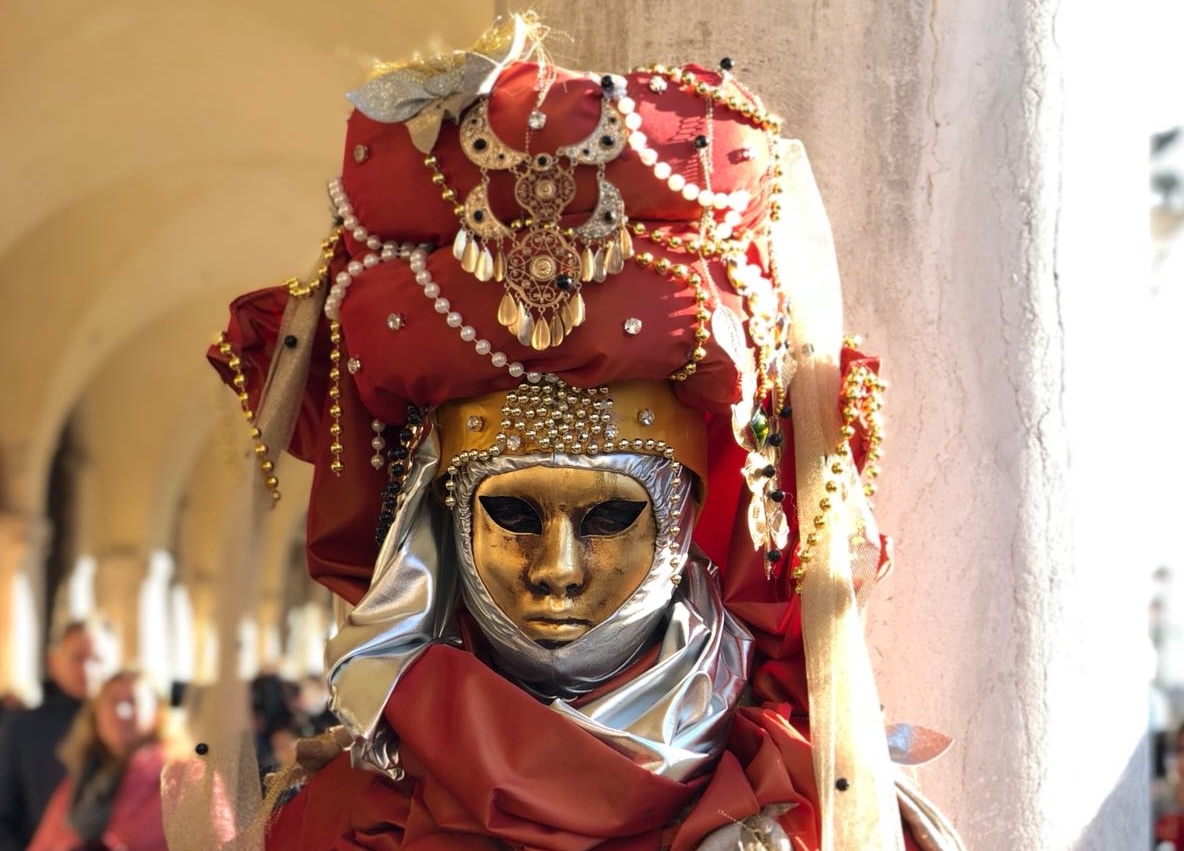
Each year, as winter tightens over the lagoon and the light goes grey and horizontal, Venice prepares for its oldest and most theatrical transformation. Carnival has roots in Venetian life documented as early as the eleventh century — first recorded in 1094, and declared a public holiday by the Republic in 1296. Its modern iteration is enormous — the city's population multiplies, the streets fill with elaborate historical costumes that arrive from ateliers across Italy and Central Europe, and the campo in front of San Polo, the Piazzetta dei Leoni, the quaysides along the Grand Canal all become stages for a spectacle that is simultaneously spontaneous and deeply choreographed.
In 2027, Carnevale di Venezia runs from 23 January to 9 February — a period in which the city transforms with an intensity that rewards those who know how to read it. Planning privately around Carnival is something we do every year it occurs: from the choice of property to the particular events and moments within the programme that are worth seeking out versus those that are better observed from a considered distance. The knowledge of which costumier, which private gathering, which dawn walk through an emptying campo will endure in memory — this is not information that circulates in public. It comes from returning, year after year, and from understanding Carnival not as spectacle to be witnessed but as a city temporarily inhabiting a different version of itself.

The Longer Register
Venice does not reveal its deeper register quickly. Four or five days, or longer, is what the city actually rewards — enough time for the light to change more than once over the same calle, for a neighbourhood to become familiar rather than merely visited, for the particular rhythm of the lagoon to settle into something that begins to feel like your own.
A private journey through Venice, shaped by this quality of accumulated knowledge, is measured not by the number of things accomplished but by the quality of the relationship formed — with the city, with its light, with its particular rhythm of high water and low tide and the bell that rings across the campo each morning at seven. The guests who return to Venice year after year have understood something that is not articulable in advance. It can only be experienced.
Venice is also, with the right approach, a city that gives itself generously to families. A child who has stood at the shoulder of a glassblower and watched molten material take shape in the heat, who has tried their hand at decorating a mask in the traditional manner, who has seen the hull of a gondola being worked from raw timber in one of the last surviving squeri — that child will carry a memory of Venice that is specific and lasting in a different way from what the museums alone offer. The lagoon crossing to Burano, the bridge to Mazzorbo, the taste of something grown on an island entirely surrounded by salt water: these are experiences that work on adults and on children in the same register, which is the register of the specific and the irreplaceable.
Dorsoduro at six in the morning, before the city has decided what day it is. The smell of bread from the bakery behind the Carmini church. The canal below the window, dark and barely moving. Venice is a city that gives itself to those who stay long enough, and we exist, in part, to make that staying possible.
For an earlier portrait of the city — its light, its silence, and the water that holds it all — read Journey to Venice: Step Inside a Living Masterpiece.
To enquire about a private Venice journey, please write to us.
Private by nature. Extraordinary by design.
Frequently Asked Questions - Venice, Italy
What makes this approach to Venice different from what other luxury travel companies offer?
Every journey is arranged entirely for your travelling party, without intermediary or group programme. What distinguishes this approach is that it is rooted in Melissa Martin's own sustained relationship with the city — built across many years of returning, of knowing particular custodians by name, of understanding which season suits which neighbourhood and which moment in a given day rewards attention. That quality of personal familiarity cannot be assembled before a first visit. It is the foundation on which each Venice journey is designed.
Which hotels do you work with in Venice?
The three properties we work most closely with are The Gritti Palace, A Luxury Collection Hotel; Aman Venice (Palazzo Papadopoli); and Hotel Cipriani, A Belmond Hotel. Each occupies a distinct position — the Gritti directly on the Grand Canal at the bend toward the Salute; Aman further along the same canal, with soaring frescoed ceilings and a private garden; the Cipriani on the Giudecca, offering the city as a skyline. We also arrange private palazzo rentals and boutique properties of comparable distinction. The choice of property shapes the entire journey.
Can you arrange access to the Venice Biennale Arte?
Yes. The current edition — the 61st International Art Exhibition, "In Minor Keys" — runs across the Giardini, the Arsenale, and satellite venues throughout the city until 22 November 2026. Attempting the full circuit in a single day reduces it to logistics; the Arsenale alone warrants a half-day. We structure private engagement around each guest's specific interests — particular national pavilions, individual works, palazzo venues most visitors never locate — rather than a standard circuit. The city itself, experienced between venues, is always part of the engagement.
Is Venice Carnival something you can plan around?
Yes. Carnival has been woven into Venetian life since the eleventh century, with the first documentary record dating to 1094. The 2027 edition — Carnevale di Venezia — runs from 23 January to 9 February. Planning privately around it means knowing which events and gatherings reward immersion, which are better observed from a considered distance, and which early mornings — before the city resets for another day of spectacle — offer something the afternoon cannot. We arrange all of this on an exclusive-use basis, year after year.
Are Venice journeys arranged privately?
Yes. Each journey is designed for your travelling party, with private guides and privately chartered boats. Cultural venues and public events may also welcome other visitors. Where exclusive venue access or an after-hours visit is requested, we confirm the arrangements individually before including them in your itinerary.
Can you arrange meetings with Venetian artists and artisans?
Yes. Venice sustains a community of working craftspeople — glassmakers, mask-makers, bookbinders, gilders — whose workshops are not on any public map and whose output supplies institutions rather than souvenir counters. We arrange private studio visits: time spent with master craftspeople who can speak to the history and technique of their work, not as a demonstration but as a conversation. These encounters are exclusive-use, arranged on the basis of direct, long-standing relationship, and tend to be among the most lasting memories a Venice journey produces.
Can you arrange exclusive private events in Venice?
Yes. A palazzo overlooking the Grand Canal — original frescoed interiors, candlelit, with costumed staff in historical Venetian dress — can be arranged on an exclusive-use basis for a privately held dinner, with Michelin-starred culinary teams and Venetian musicians. For those planning wedding ceremonies, Venice offers settings of exceptional rarity: private indoor spaces of extraordinary provenance, and rooftop settings above the lagoon's rooflines. The nature of what is possible depends on occasion, timing, and the conversation that precedes it.
How many days should we spend in Venice?
Four or five days is what the city genuinely rewards — enough time for the light to change more than once over the same calle, for a neighbourhood to become familiar rather than merely visited, and for the rhythm of the lagoon to settle into something that begins to feel like your own. Shorter stays are possible, but Venice's deeper register only opens to those who allow it time. Longer stays, particularly in the quieter seasons, often become the journeys guests return to describe most specifically.
Is this suitable for families?
Yes. Venice gives itself generously to families. A child who has stood at a glassblower's shoulder, tried their hand at decorating a mask in the traditional manner, or seen a gondola hull worked from raw timber in one of the last surviving squeri, carries a memory of Venice that is specific and lasting. The lagoon crossing to Burano, the bridge to Mazzorbo, the taste of something grown on an island surrounded by salt water — these experiences work on adults and children in the same register.




.jpg)